I want to say something plainly that doesn't get said often enough in this industry.
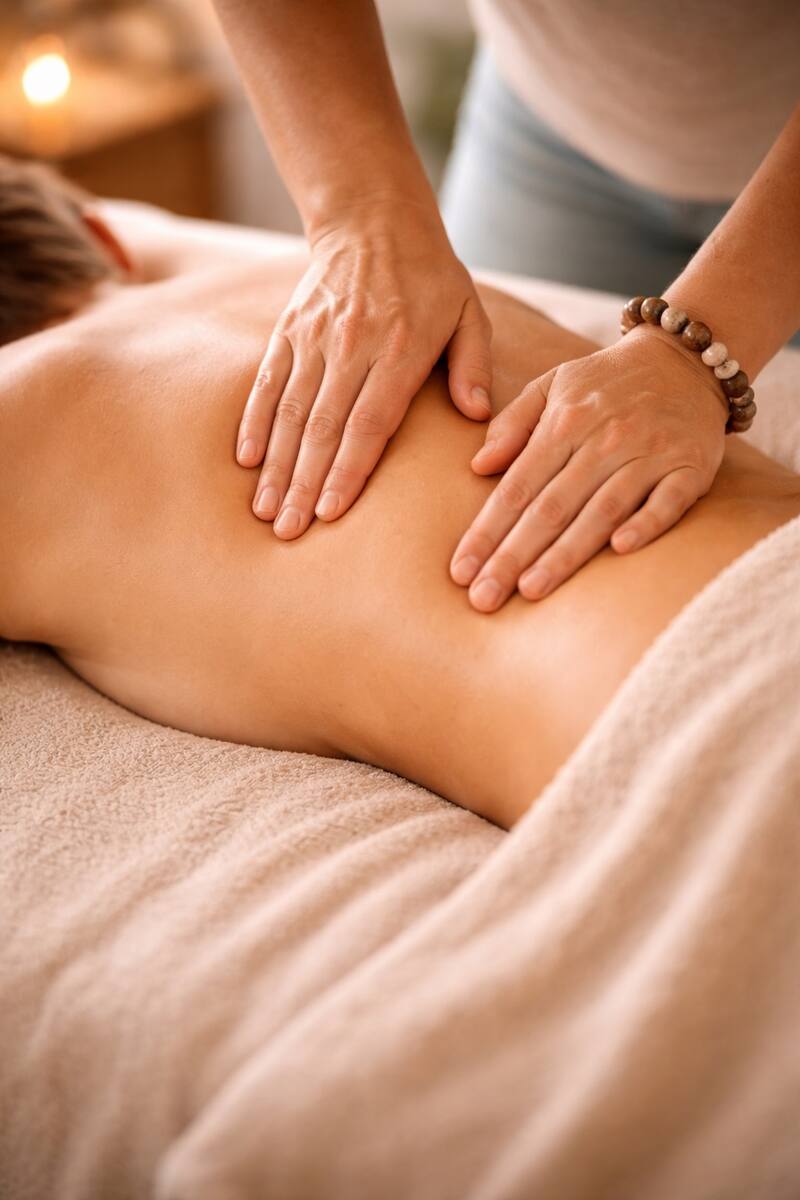
Massage, done well, is one of the most powerful tools available for changing how a body feels, moves, breathes, and functions. I believe that completely. I've seen it too many times to doubt it.
But massage that only addresses the symptom — the tight muscle, the tender spot, the area that hurts — without addressing the pattern underneath it will provide relief that fades. Not because the work was bad. But because the work was incomplete. It reached the surface of something without touching the root.
Most people who receive regular massage know this experience intimately. Something releases in the session. Walking out, there's lightness, ease, a breath that goes somewhere it hasn't been in months. And then, within a few days — sometimes within hours — the familiar tension begins to reassert. The shoulders climb back up. The low back locks again. The neck pulls forward. And the person comes back, wondering whether they just need more frequent sessions, whether their body is somehow resistant, whether something is fundamentally wrong.
Nothing is fundamentally wrong. But there are real, specific reasons why patterns return. And understanding them changes everything about how you think about bodywork, about your own body, and about what change actually requires.
There are three mechanical reasons. And then there is a fourth one — the one that goes deeper than mechanics — that I think is the most important thing I can say in this series.
The Three Mechanical Reasons
The Correct Sequence — And Why Order Matters
Before we get to the fourth reason, it's worth being precise about what good bodywork actually does mechanically — because sequence matters enormously, and most sessions that don't hold are missing a step.
Release the tight, dominant, overactive tissues first. This isn't the end of the work — it's the beginning. Creating space in the compressed areas removes the primary driver of inhibition in the opposing muscles.
Once tone is reduced, the layers need to move against each other again. Muscle over muscle, muscle over bone, fascia over organ. Glide is what makes the system feel fluid rather than stuck.
This is the step that most commonly gets skipped — and its omission is why most patterns return. The muscles that went quiet need a clear neurological signal to come back online. Serratus anterior. Lower trapezius. Deep cervical flexors. Glute medius. Without this step, the dominant muscles simply reassert.
Give the newly available body a movement to practice. Something simple that reinforces the new joint relationship — often connected to breathing, because breath is both the most accessible movement and the most fundamental stabilizer.
The pattern didn't live in one muscle. Lasting change means the new organization travels through the whole system — the way the foot loads, the way the pelvis responds, the way the breath moves the ribs. Integration is what makes the change feel natural rather than effortful.
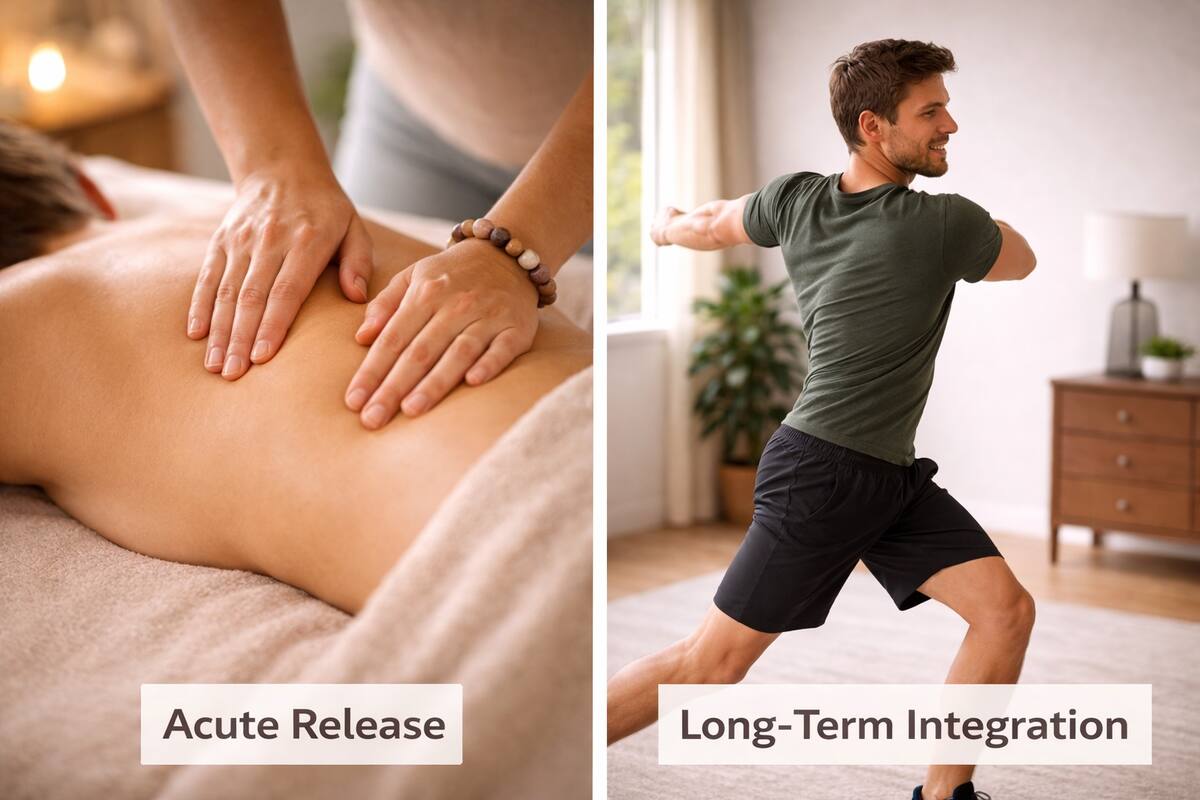
When this sequence is followed, results hold longer. Not permanently — because of the three mechanical reasons above — but significantly longer than when the session is simply "work on what's tight." The difference isn't subtle. Clients who receive work that follows this sequence consistently report that the changes last days or weeks rather than hours. The pattern has genuinely shifted, not just temporarily relaxed.
To be direct: most massage — good, well-intentioned, skilled massage — addresses step one and sometimes step two. Release the tight tissue. Improve circulation. Create relief. This is genuinely valuable, and there's nothing wrong with it as far as it goes.
What it typically doesn't address is step three: activating the inhibited side. And without that step, the dominant muscles have nowhere to offload to. So they come back. Every time. Not because your body is broken or resistant, but because the structural reason for the compensation was never resolved.
This is worth knowing — not to criticize any particular approach, but because understanding it gives you agency. You can ask for it. You can look for it. You can understand what you're receiving and why it does or doesn't hold.
What Massage Actually Does — Honestly
Let's be precise about this, because I think clarity here is more useful than reassurance.
- Reduces dominant muscle tone, creating space for inhibited muscles to activate
- Restores fascial glide, improving movement quality and reducing compensatory recruitment
- Improves joint centration, allowing muscles to fire from better mechanical positions
- Regulates the nervous system, shifting from sympathetic dominance toward parasympathetic recovery
- Reveals the pattern — makes it visible to client and therapist in a way that's hard to access otherwise
- Provides a new proprioceptive reference point — a felt sense of what a less compressed body feels like
- Override the nervous system's established motor map without consistent new input
- Remodel fascial architecture without time and repeated stimulation
- Activate inhibited muscles — that requires neurological input, not just mechanical release
- Change the habits, postures, and movements that recreated the pattern in the first place
- Replace the awareness and presence that the client brings — or doesn't bring — between sessions
This isn't a limitation of massage. It's a limitation of any intervention that happens to a passive body. The body is not a car that can be fixed by a mechanic while you wait. It is a living system that participates in everything that happens to it — including its own healing.
Here is the thing I think matters most — and the thing that's hardest to say, because it asks something of people rather than just offering them something.
The compression patterns we've traced through this series — the forward head, the lopsided shoulder, the rotational spiral, the collapsed chest, the braced ribs — these are not random mechanical failures. They are the body's faithful record of a life. Of the demands that have been placed on it, the emotions it has been asked to carry, the postures it has held under pressure, the ways it has learned to stay safe.
The body doesn't hold a pattern without reason. Every compression, every holding, every place where tissue has thickened and movement has narrowed — it was adaptive once. It was the body's best response to something real. And in some cases, it still is.
This is why massage helps — sometimes profoundly — but doesn't by itself change the pattern long-term. Because the pattern isn't just in the tissue. It's in who the person is at this moment in their life. It's in the pace they keep, the load they carry, the way they relate to their own discomfort, the things they haven't yet found words for. The massage reveals the pattern. It creates space in it. It gives the nervous system a taste of what less compression feels like. But the pattern returns because the life that created it is still being lived — often in the same way, with the same habits, carrying the same load.
Lasting change requires something that a session alone cannot provide: awareness. Genuine, present, non-judgmental attention turned toward the body and what it's actually doing. Not the attention of correction — not "I need to sit up straighter" or "I have to fix my posture." The attention of curiosity. Of honest noticing. I'm holding my breath. My shoulders are up near my ears again. There's that tension in my jaw that arrives whenever I open my inbox.
That noticing — without the impulse to immediately fix what you notice — is the beginning of real change. Because you cannot shift a pattern you haven't acknowledged. And you cannot acknowledge a pattern you've been trained to override.
The pattern isn't your enemy. It's asking for something. Usually: awareness, space, and permission to soften when the conditions that created it are no longer present. The work of a good massage session is to create those conditions temporarily, and to give the client enough felt sense of them to recognize when they're absent. The work that happens between sessions — the noticing, the pausing, the willingness to feel what the body is actually doing rather than what you wish it was doing — that's where the pattern actually changes.
There is effort required on your side. Not the effort of forcing or correcting. The effort of showing up — to your body, to your pattern, to the reality of what you're carrying and whether you're ready to set some of it down.
What This Means in Practice
I want to be concrete about what this actually looks like, because "body awareness" can sound abstract in a way that makes it feel inaccessible.
It doesn't require a formal practice, or a meditation cushion, or any particular technique. What it requires is a quality of attention that most people already have access to — they've just been taught to apply it everywhere except their own bodies.
It looks like this: at some point during your day — ideally several times — you stop and take a genuine inventory. Not a corrective inventory. Not "what's wrong and how do I fix it." Just: what is actually here right now? Where is there tension? Where is there ease? What is my breath doing? What does my jaw feel like? Where are my shoulders relative to my ears?
And then — this is the part that takes practice — you stay with what you find for a moment before you do anything about it. You let it be there. You get curious about it rather than moving immediately to fix it. Because the impulse to immediately correct what you notice is itself part of the pattern. It's the nervous system's habit of managing discomfort by acting rather than feeling. And acting rather than feeling is, in many cases, exactly what built the pattern in the first place.
What we're describing here is presence. Not the performance of presence — not trying to seem relaxed or appear calm — but genuine contact with your own experience in this moment. It sounds simple. It's genuinely not easy. But it is learnable. And it is, in my experience, the single most important thing a person can bring to their own healing process.
Massage, done well, is a remarkable ally in that process. It creates conditions that make presence easier — reduced tone, better breathing, a quieter nervous system. It shows you what's possible in a body that has more space. And it gives you a reference point to return to between sessions: I felt that. I know that's available. I want to find my way back there.
That reference point is not nothing. In many ways, it's everything.
In Post 6, we go deeper into the 12 postural archetypes introduced at the beginning of this series — specifically into what each pattern is holding emotionally, and what it actually needs in order to feel safe enough to release. Because the body won't let go of a pattern until it trusts that something else is available to hold what the pattern has been holding. Understanding that dynamic changes everything about how we work with the body and how we work with ourselves.