
Here's a question worth sitting with: when did you last hold your phone below eye level and notice your head tipping forward to meet it? When did you last work at a computer for more than an hour without your chin inching closer to the screen? When did you last drive for forty minutes and feel your neck tighten on one side?
If you're like most people, the honest answer is: today. Probably within the last hour.
Forward head posture — sometimes called tech neck, sometimes called anterior head carriage — is the most common compression pattern alive right now. It's estimated that for every inch your head drifts forward from its neutral position above your shoulders, the effective weight your neck has to support increases by roughly ten pounds. The average adult head weighs ten to twelve pounds sitting in neutral. Three inches forward? Your neck is managing something closer to forty.
But here's what most conversations about tech neck miss entirely: this isn't just a neck problem. It isn't even just a posture problem. Forward head posture is a full-body compression cascade — a pattern that reorganizes your muscles, your breathing, your digestion, your nervous system, and even your energy levels. And by the time you feel it in your neck, the downstream effects are already well underway.
Let's trace exactly what happens, from the top of your skull to the soles of your feet.
What Forward Head Posture Actually Is
When we talk about forward head posture, we're describing a very specific multi-zone compression — not just a "slouch." There are three things happening simultaneously in the cervical spine when the head migrates forward:
The occiput — the base of your skull — extends backward. The mid-cervical vertebrae flex forward. And the lower cervical vertebrae extend again to compensate. This creates a kind of S-curve in the neck, with different segments moving in opposite directions, all trying to keep your eyes level with the horizon because your visual system demands it regardless of what the rest of your spine is doing.
Meanwhile, the thoracic spine — the mid-back — has to kyphose, rounding forward to accommodate the shift. Your shoulders follow. Your ribcage compresses. And the chain reaction begins.
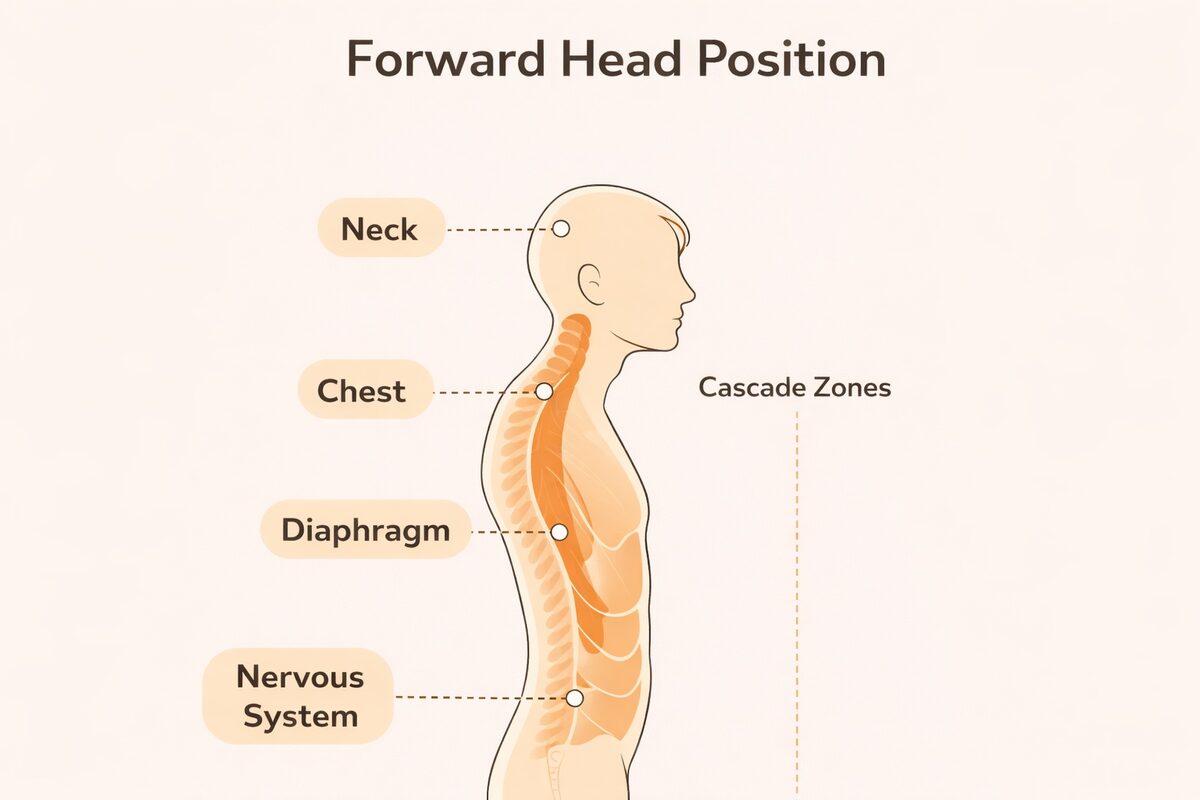
Forward head posture isn't just "forward head." It's a multi-zone compression that reorganizes the entire body from the skull to the pelvis — changing how you breathe, digest, feel, and recover.
The Full-Body Cascade: What's Actually Happening
The body is a tensegrity structure — one continuous web of fascia, muscle, and connective tissue where tension in one place transmits through everything. When the head shifts forward, the entire system has to reorganize. Here's what that looks like, zone by zone:
The Tonic-Phasic Breakdown: Why Your Muscles Stop Working Correctly
Here's something that surprised me when I first learned it, and I think it'll surprise you too.
The muscles in your body come in two broad categories. Tonic muscles are your postural muscles — slow-twitch, endurance-oriented, designed to hold you up against gravity all day. They're on constantly, in the background. Because of this, they have a neurological tendency to tighten, shorten, and become overactive over time, especially under stress or sustained load.
Phasic muscles are your movement muscles — fast-twitch, designed for power and dynamic action. They're supposed to fire when you need them and rest when you don't. The problem is that phasic muscles tend to weaken, lengthen, and switch off under stress — especially when the tonic muscles around them are dominating.
In forward head posture, this imbalance is textbook. And it runs throughout the entire body:
| Overactive — Tonic (tight, dominant) | Inhibited — Phasic (weak, switched off) |
|---|---|
| SCM (sternocleidomastoid) | Deep cervical flexors (longus colli/capitis) |
| Scalenes | Serratus anterior |
| Suboccipitals | Lower trapezius |
| Pec minor / pec major | Rhomboids |
| Upper trapezius | Middle trapezius |
| Levator scapulae | Deep neck flexors (longus colli) |
What this creates is a muscle firing sequence problem. Tonic muscles fire early — even when they shouldn't. Phasic muscles fire late, or not at all. The SCM dominates before the deep neck flexors can stabilize. The upper trap fires before the serratus can set the scapula. And the body keeps compensating, keeps recruiting the wrong muscles to do the wrong jobs, and the pattern deepens.
This is why the classic advice — "just strengthen your neck" or "do more chin tucks" — often doesn't hold. You can't reliably activate the inhibited muscles when the dominant muscles are still running the show. The tonic muscles need to be released first. Then the phasic muscles can be woken up. Then movement can be repatterned. In that order.
Here's a principle worth carrying with you: in the body, where one area stabilizes, an opposite region must be free. Movement is always a relationship between a fixed anchor and a moving segment.
In forward head posture, the anchor — the cervical spine — has lost its stability. So the mover — everything downstream — overworks to compensate. Releasing the pattern isn't just about relaxing tight muscles. It's about restoring the proper relationship between what holds and what moves.
The Archetype: "The Bracer"
In the first post of this series, we introduced the 12 postural archetypes — recognizable patterns that show up across different bodies with consistent structural and emotional signatures. Forward head posture most commonly lives inside what we call The Bracer.
The Bracer's structural signature: ribs locked down, shoulders elevated, scalenes and SCM rigid. This is a body on guard. The physical structure says: something might be coming, and I need to be ready for it. The muscles aren't just tight — they're held, continuously, in a low-grade state of preparation.
The emotional signature of this pattern tends toward anxiety, hypervigilance, and chronic low-level fear. Not dramatic fear — more the background kind. The kind that makes it hard to fully exhale, hard to let the shoulders drop, hard to stop monitoring. The kind that keeps the nervous system just slightly elevated all the time, which as we've seen, is exactly what the forward head compression pattern creates physiologically.
It's worth saying again: the emotional dimension here isn't metaphor. The same nervous system that produces anxiety produces muscle tension. They're one system. Which is part of why addressing the physical pattern — genuinely releasing it, not just temporarily relaxing it — can have such a meaningful effect on how someone feels, not just how their neck moves.
Your Body Confesses It While You Sleep
One of the most revealing clinical questions I ask clients is this: how do you wake up? Not what time. How do you feel when you first get up — specifically in your neck, your jaw, your upper back?
Because sleep position is essentially a long-duration postural load. Six to eight hours, no muscular support, no conscious correction. Whatever pattern your body defaults to when it's off-guard — that's what it holds all night.
For someone in a forward head pattern, there are predictable traps:
There's also a fascinating layer here that I love: at night, fascia becomes more gel-like. Prolonged compression causes what's called viscous deformation — the tissue slowly conforms to the load it's under. This is why you wake up stiff and then gradually loosen up as you move. You're literally re-warming your fascia back from gel to a more fluid state. But if your sleep position is compressing the same tissues that are already compressed during the day, you're essentially resetting to the pattern every single morning before you've even gotten out of bed.
The Positions You Default To Are Telling You Something
Beyond sleep, there's something incredibly revealing about the positions people gravitate toward when they're resting, relaxing, or just existing without thinking about it.
Two comfort positions show up constantly in people with forward head patterns:
Positions of comfort are the body's confessions. People don't find these positions at random — they find them because they reduce the tension in whatever fascial chains are most loaded. Once you start reading them that way, you see the underlying pattern immediately, without a single hands-on assessment.
Why "Just Sitting Up Straight" Doesn't Work
I want to address this directly, because it's probably the most common advice people receive about forward head posture — and it's the advice that frustrates people most, because they try it and it doesn't hold.
The reason postural corrections don't stick isn't willpower or laziness. It's that correction without release is just adding one muscular effort on top of an existing compensation pattern. When the tonic muscles are dominant and the phasic muscles are inhibited, "sitting up straight" just means recruiting the wrong muscles harder. The moment you stop actively thinking about it — which will happen, because you have a life to pay attention to — the body goes right back to its default.
True stability isn't stiffness or active bracing. It's efficient control with minimal effort — the deep stabilizers doing their job quietly in the background, the global muscles free to move rather than hold. That kind of stability only becomes available after the dominant tonic muscles have been released, the joint positions have been restored, and the phasic stabilizers have been woken back up.
The correct sequence, always, is: release first, then activate, then repattern. Not correct first and hope the rest follows.
Is forward head posture part of your pattern?
- Stand with your back against a wall. Can your head touch the wall comfortably, or does it float forward?
- Do you regularly get headaches at the base of your skull or behind your eyes?
- Does your jaw feel tight, click, or ache — especially in the morning?
- Do you experience fatigue that doesn't seem proportional to your activity level?
- Do you have a "pinched" feeling in one shoulder blade that never quite resolves, no matter how much you stretch it?
- Do you tend to prop your head up on your hand when reading or resting?
- Does your breathing feel more comfortable in your upper chest than deep in your belly?
If several of those landed, forward head posture is likely part of your picture. Which is genuinely not alarming — it's extraordinarily common. But it is worth understanding, because the downstream effects are real, and they compound over time.
What Helps — And What the Right Sequence Looks Like
Manual therapy — specifically the kind that works with the fascial system rather than just the surface muscles — is particularly effective for forward head patterns precisely because it can address the cascade at multiple levels simultaneously. A session that releases the scalenes and SCM, mobilizes the thoracic spine and ribcage, decompresses the suboccipitals, and restores the diaphragm's range of motion isn't just treating a tight neck. It's interrupting the entire compression chain.
Between sessions, the things that support the pattern shifting are less about specific exercises and more about awareness: noticing when you're propping your head up, noticing whether your jaw is clenched while you work, noticing whether your breath is moving your chest or your belly, noticing what happens in your neck when you've been on a screen for an hour.
That noticing — without judgment, just honest observation — is what creates the opening for the pattern to actually change. You can't change what you can't see. But once you can see it, it starts to shift.
In the next post, we move from forward head posture to lateral neck tilt — the lopsided shoulder pattern that almost everyone has, and the surprisingly extensive downstream effects of something that most people don't even notice they're doing.