
I want to start with something I notice every single day in my work as a massage therapist.
A client walks in. They haven't said anything yet — they're just crossing the room to sit down. And in that ten-second walk, I already know a tremendous amount about where they're holding tension, what their breathing is like, which side of their body is doing more work than the other, and sometimes — in a way that's hard to explain but impossible to ignore — something about what they've been carrying emotionally.
The body is always communicating. It never stops. Most of us just haven't been taught how to listen.
This series is about changing that. Over eight posts, we're going to go deep into compression patterns — the ways the body collapses, guards, braces, twists, and compensates — and what they mean for your pain, your breathing, your energy, and even your emotional life. We'll look at specific patterns like forward head posture, lateral tilt, and rotational compression. We'll talk about why massage sometimes doesn't hold. And eventually we'll get to something that doesn't usually get discussed in wellness blogs: the relationship between how you hold your body and what you're holding inside it.
But first, we need to establish the foundation. Because none of the rest of this makes sense without understanding one core idea.
When one area of the body collapses or compresses, the entire system reorganizes around that collapse. Your body doesn't experience tension in isolated parts — it experiences it as a whole.
Your Body Is One Continuous Web
Here's something that changed the way I understand the human body, and I think it'll change the way you understand yours.
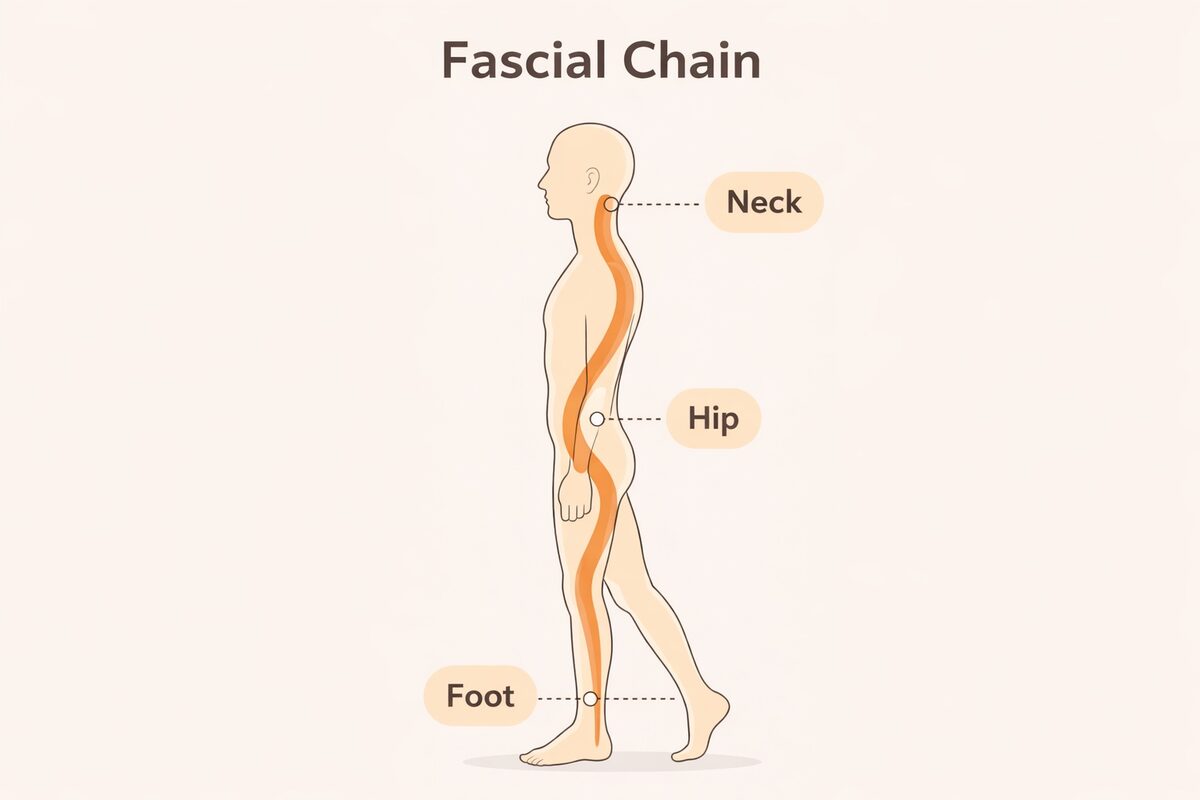
You've probably heard of muscles, tendons, and ligaments. But there's a tissue that connects all of them — and honestly, connects everything — called fascia. Think of it as a continuous three-dimensional web that runs from the top of your head to the soles of your feet, wrapping around every muscle, organ, nerve, and bone in your body. It's everywhere. It's everything.
What makes fascia extraordinary is that because it's continuous, tension in one place transmits through the whole system. Tightness in your neck can pull on your shoulder, which tugs on your mid-back, which rotates your pelvis, which loads one hip more than the other, which changes how your foot hits the ground. A compression in the neck can echo all the way down to your hips, your feet, and even your internal organs.
This is why your "bad knee" might actually be a hip problem. It's why your headaches might be coming from your jaw. It's why that one side of your back that never quite loosens up might be responding to tension that started somewhere else entirely.
Structural engineers have a word for this kind of system: tensegrity. It describes a structure that maintains its shape not through rigid connections, but through a continuous balance of tension and compression throughout the whole. Your body works exactly this way. It's not a stack of bones held together with muscles — it's a tensegrity structure, alive and dynamic, where every part is in constant conversation with every other part.
What "Compression" Actually Means
When we talk about compression patterns in the body, we're talking about something very specific — and it's probably not what you think.
We're not just talking about being "tight." We're talking about what happens when one area of the body collapses — forward, sideways, or rotationally — and the rest of the body has to reorganize around that collapse to keep you upright.
Compression means reduced space. And reduced space creates a cascade:
Reduced space → less room for tissues to glide past each other → reduced circulation and lymphatic flow → altered nerve signaling → changed breathing mechanics → shifted organ position and function.
This is why compression isn't just a structural problem. It affects your nervous system, your digestion, your breathing, your energy levels, and your ability to fully relax.
The three main postural compression patterns we'll be covering in this series are forward head posture (the one most people with a desk job or a smartphone are living in right now), lateral neck tilt (the lopsided shoulder that almost everyone has to some degree), and rotational patterns (the spiral twist that builds up when you habitually favor one side). Each one creates a unique downstream effect throughout the whole body — and each one has both a physical and an emotional dimension that we'll explore together.
Your Posture Is Not a Bad Habit. It's an Adaptation.
This is important, and I want to say it clearly: your posture is not a personal failure. It is not laziness. It is not something you could have prevented by "sitting up straight" enough times.
Your body has developed its current patterns in response to your life. The hours you spend at a screen. The side you sleep on. The accident you had three years ago. The grief you carried after a loss. The job that keeps you in one position for eight hours a day. The sport you played for twenty years. All of it leaves an imprint.
In fact, when a region of the body collapses into a compression pattern, something really intelligent is happening underneath. Muscles on one side shorten and become overactive — they're holding the structure together. Muscles on the other side lengthen and become inhibited — they're essentially switched off, because activating them would feel unstable to the nervous system. It's not dysfunction. It's the body's best attempt at safety given the circumstances.
The problem is that what starts as an adaptation becomes a pattern. And patterns, over time, become the default. And defaults, over years, become the source of the chronic pain, limited breathing, digestive sluggishness, and low-grade fatigue that so many people accept as just part of getting older.
It doesn't have to be that way. But you can't change a pattern you can't see.
Reading the Map: 12 Ways the Body Speaks
One of the most powerful things I've encountered in my practice is the idea of postural archetypes — recognizable patterns that show up again and again across different bodies, carrying not just structural signatures but emotional ones too. These aren't rigid categories. Most people are a blend of two or three. But they're remarkably consistent. Here are all twelve — see if you recognize yourself or someone you love.
Did you recognize yourself? Most people see two or three that feel uncomfortably accurate. That's not a coincidence. These patterns are so consistent because the body is responding to universal human experiences — stress, grief, effort, protection, fatigue — using the same physical language across millions of different people.
The Body Holds What the Mind Can't Yet Say
I want to say something here that might feel a little different from what you'd expect in a massage therapy blog.
The emotional dimension of these patterns isn't metaphor. It isn't "woo." It's actually grounded in straightforward neuroscience and physiology. Your nervous system is the same system that runs your emotional responses and your muscular tension. They're not two separate systems communicating — they're one system expressing itself in different ways simultaneously.
When you've lived through something that required you to brace — a period of sustained stress, a relationship that asked you to stay small, a profession that demands performance — your nervous system doesn't separate the emotional experience from the physical one. It encodes both together. The tissue holds the memory of the adaptation.
This is why massage can sometimes bring up unexpected emotions. It's not because something went wrong. It's because when the physical pattern releases, the emotional pattern that was living inside it gets some space too. That can be disorienting if you don't know it's coming. Once you know — it's actually one of the most profound things the body can offer.
We'll go much deeper into this territory in Post 7 of this series. For now, it's enough to hold this lightly: your body isn't just shaped by what you do. It's shaped by what you feel, what you've protected yourself from, and what you haven't yet found words for.
The body doesn't lie because it doesn't know how. It only knows how to adapt, protect, and hold — until something gives it permission to let go.
What This Series Will Cover
Over the next seven posts, we're going to build this understanding layer by layer. Here's where we're going:
The full downstream cascade of forward head posture — from your breathing to your digestion to your energy. The most common compression pattern alive right now, and the one most people are living in without knowing it.
Lateral neck tilt and ipsilateral compression — what that lopsided feeling in your shoulders is actually doing to your lungs, your pelvis, your kidneys, and your right knee.
Rotational and spiral compression patterns — the helical torque that builds up in people who always work to one side, drive long hours, or favor one hand.
Body collapse, inhibited muscle, and the correct sequence for changing a pattern rather than just temporarily relieving it. This one will change how you think about what bodywork is actually for.
A deeper look at the 12 archetypes and their emotional-fascial signatures. What each pattern is holding, and what it needs in order to feel safe enough to release.
The signature post of this series. Collapse, bypass, grounded presence. The relationship between emotional patterns and physical ones — and what it actually means to let something go.
Clinical red flags for over-compression. The signs that deeper layers — neurological, visceral, lymphatic — are involved and what to do when you recognize them.
One Thing to Try Before the Next Post
Before we go any further, I want to give you something practical to do right now. Not an exercise. Not a stretch. Just an experiment in awareness.
At some point today, stop what you're doing and take a genuine inventory of where you are in your body.
Notice where your head is relative to your shoulders — is it sitting directly above them, or is it forward, like it's trying to get somewhere ahead of the rest of you? Notice which shoulder sits higher. Notice whether your weight is evenly distributed between both feet, or whether you habitually load one side. Notice how you're breathing — is it high and shallow in your chest, or is there movement in your belly and the sides of your ribs?
Don't try to fix anything. Don't "sit up straight." Just notice. With curiosity, not judgment.
That moment of noticing — that's where change actually begins. Not in the correction. In the awareness that makes correction possible.
Everything in this series is written for educational purposes — to help you understand your body more deeply and make more informed choices about your health and wellbeing. It is not medical advice, and nothing here is intended to diagnose or treat any condition.
That said, understanding your own patterns is genuinely powerful. The more clearly you can see what your body is doing and why, the more agency you have in working with it — whether that's through massage, movement, breath, or simply the practice of paying attention.
See you in Post 2 — where we're going to talk about the one compression pattern that almost every person alive right now is dealing with, whether they know it or not.