Services Products About Contact Gift Cards Blog Book Now
Deep Tissue · Eastern Methods
Shiatsu & Tuina

Eastern
Harmony

Where channel theory meets deep tissue practice

Two of the oldest therapeutic traditions in the world — Japanese Shiatsu and Chinese Tuina — woven together into a single session. The work moves along the body's channels and meridians, addressing not just where you hurt, but the energetic and structural patterns that create tension in the first place.
Book This Service
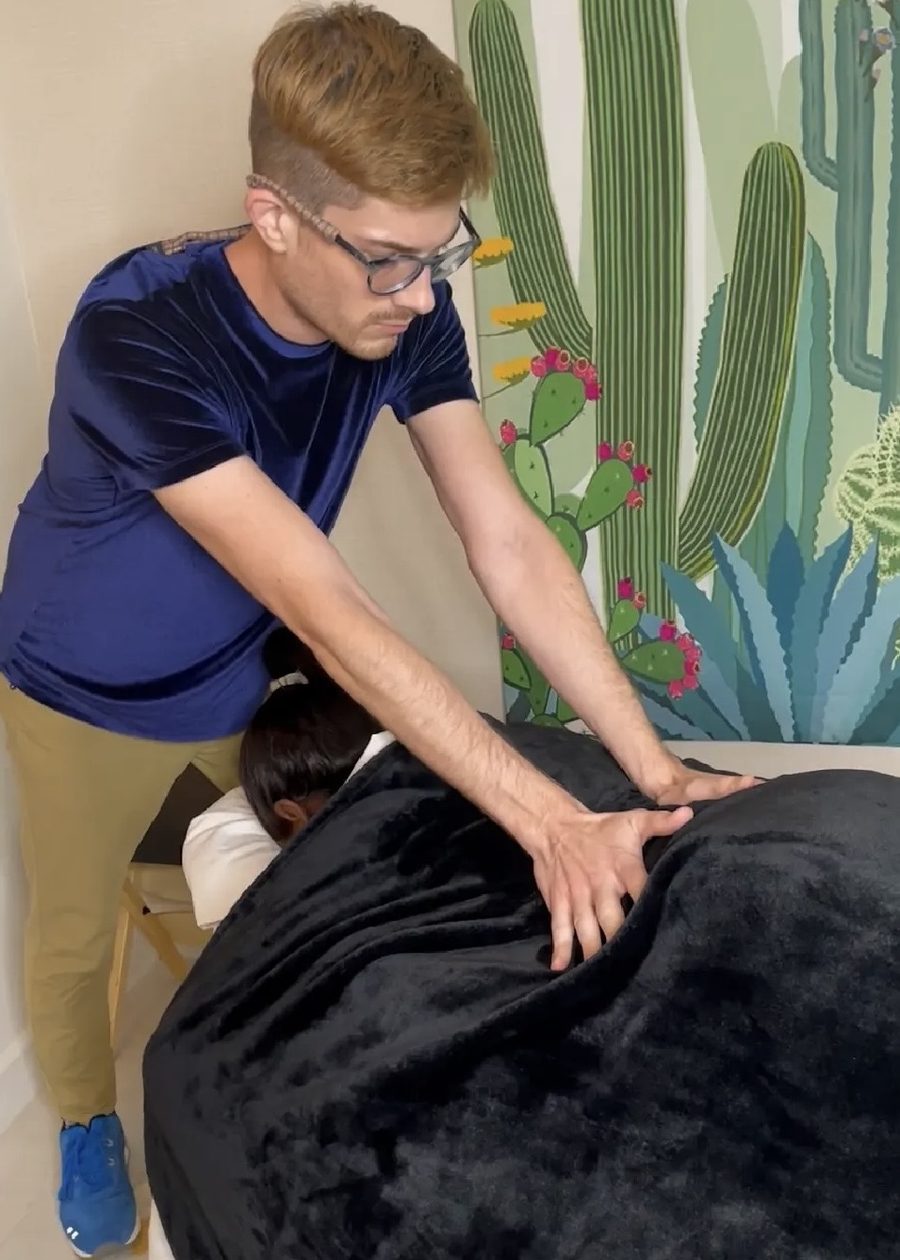
Eastern Harmony Shiatsu and Tuina at Awaken Zen Spa
Starting at
$85

Two Traditions,
One Session

Shiatsu and Tuina share the same ancient roots — both descended from Chinese medicine's understanding of Qi, channels, and the body as an energetic system. At AZS, Brant draws on both simultaneously, letting the needs of your body determine which techniques come forward at any given moment.

Japan · Developed 20th century
Shiatsu
指圧 — "Finger Pressure"

Shiatsu evolved in Japan from Anma massage and Chinese medicine, formalized in the early 20th century. It applies sustained, meditative thumb and palm pressure along the body's meridians — working with the breath, the nervous system, and the energetic quality of each channel rather than purely the muscular structure. The pace is deliberate. The contact is deep but unhurried.

Tools:Thumbs, palms, forearms, elbows, knees
Medium:No oil — performed through clothing or directly on skin
Emphasis:Sustained pressure, energetic balance, nervous system regulation
Speed:Slow, meditative — breath is central to technique
China · Ancient origins
Tuina
推拿 — "Push and Grasp"

Tuina is one of the five branches of Traditional Chinese Medicine alongside acupuncture, herbal medicine, Qi Gong, and diet. Its techniques are more varied and dynamic than Shiatsu — rolling, kneading, grasping, plucking, and striking along channels and at specific acupoints. It treats not just pain and tension but the underlying patterns of deficiency, stagnation, and excess that create them.

Tools:Full hand repertoire — knuckle, palm, elbow, forearm
Medium:Often with oil or through light clothing
Emphasis:Dredge channels, move Qi and Blood, address root patterns
Speed:Variable — rhythmic rolling to brisk dispersal

Choose Your Duration

Eastern Harmony is available in three lengths. Longer sessions allow more time to move through channels systematically and address secondary patterns that surface during the work.

Foundation
60-Minute Session

A focused channel session targeting the primary areas of holding. Suitable for maintenance, a specific complaint, or a first experience with Eastern methods. The work is concentrated and intentional — one or two channel lines addressed with depth.

60 min$85
Complete
90-Minute Session

The recommended entry point for Eastern Harmony. Enough time to move through the primary channel pairs from back to front, address secondary areas that arise, and close the session properly with integrative techniques. The work has room to breathe.

90 min$115
Extended
120-Minute Session

A full session with time to work the complete channel system — back, legs, neck, shoulders, arms, and abdomen — plus space for deeper analgesic work at stubborn points. Ideal for those with systemic tension patterns, chronic Qi stagnation, or anyone wanting the full depth of what these modalities can do together.

120 min$145

The Framework Behind the Work

To understand why Shiatsu and Tuina work the way they do, you need to understand the lens they work through. These aren't abstract concepts — they're a precise clinical language for describing how the body holds tension, where it originates, and how to shift it.

Qi — Vital Energy

The animating force that flows through the body's channels. In health, Qi moves freely. Pain, tension, fatigue, and emotional holding all arise when Qi is blocked, deficient, or in excess in a given area. The primary goal of both Shiatsu and Tuina is to restore Qi's free movement.

Jing Luo — Channels & Collaterals

The network of pathways through which Qi and Blood circulate. There are 12 primary channels (each linked to an organ system) plus 8 extraordinary vessels and a web of connecting collaterals. Shiatsu and Tuina work along these channels rather than purely following muscle anatomy — which is why they can address referred pain and systemic patterns that localized muscle work misses.

Xu & Shi — Deficiency & Excess

Every area of the body — and the person as a whole — can present as Xu (deficient, depleted, weak) or Shi (excess, full, stagnant). The appropriate technique changes entirely based on this distinction. Xu conditions require tonifying: gentle, sustained, warming pressure. Shi conditions require dispersing: brisk, strong, moving techniques. Reading this correctly is the core clinical skill.

Xue — Acupoints

Specific locations along the channels where Qi concentrates and can be most directly influenced. Unlike generic pressure points, acupoints have precise functions — some tonify specific organ systems, some release wind and cold, some calm the Shen (spirit/nervous system). Sustained work at the right point for 3 minutes can shift a pattern that years of general massage hasn't touched.

Pathogenic Factors — Wind, Cold, Damp

Chinese medicine identifies environmental and internal factors that invade the channels and cause pain. Wind-cold produces acute, moving pain and stiffness. Damp produces heavy, fixed, aching sensations. These aren't metaphors — they describe patterns that practitioners and clients recognize clearly. Techniques like Gun fa (rolling) and Ji fa (chopping) specifically "dredge the Jingluo" and clear these pathogenic factors.

Shen — Spirit / Mental-Emotional

The Shen encompasses consciousness, emotional life, and mental clarity — housed in the Heart channel. Many people arrive carrying tension that is as much emotional as physical. Certain acupoints and channel work have a direct calming effect on the Shen — which is part of why a well-done Eastern session can leave you feeling not just physically relieved, but genuinely settled.

"Pain is not the problem — it is the signal. The question is always: what is the pattern underneath it?"
— Traditional Chinese Medicine principle
The Three Levels of Treatment
I
Adaptive
Warm, open, and prepare the channels. Light technique, surface work.
II
Analgesic
Sustained pressure at specific points. Deep release, pain resolution, channel clearing.
III
Dissipative
Move and clear what was released. Brisk, rhythmic, finishing techniques.

The Full Repertoire

Tuina in particular draws on one of the most diverse technique libraries in any manual therapy tradition. Each has a specific purpose, a specific stage of treatment where it belongs, and a specific quality of contact it produces. Here's the complete toolkit Brant draws from in an Eastern Harmony session.

滚法
Gun Fa

Rolling technique using the back of the hand and knuckles. Initiated from the elbow at 120–160 cycles per minute, it generates sustained rhythmic pressure over a broad area. Therapeutic benefit builds with 20+ minutes on a single channel.

Adaptive → Analgesic
推法
Tui Fa

Pushing technique applied with thumb, fingers, palm, heel, knuckles, or elbow. Used lightly to open channels at the start of treatment; more deeply to dredge them during the session. The practitioner focuses intention at the tool before moving.

Adaptive · Channel clearing
摩法
Mo Fa

Round rubbing — a soothing, relaxing circular motion with no downward pressure, just hand weight. Applied to the abdomen, kidneys, chest, and face. Clockwise to tonify, counter-clockwise to disperse. "Think of polishing something precious."

Adaptive · Tonifying · Harmonizing
擦法
Ca Fa

Scrubbing technique that generates heat along a channel or region. Rapid, linear friction that warms the channels deeply. Particularly effective for cold-type conditions and areas of damp accumulation.

Adaptive · Warming
一指禅推法
Yi Zhi Chan Tui Fa

One-finger meditation. A small, focused, rhythmic rocking of the thumb propelled by wrist and forearm — applied to a single point with prolonged attention. To tonify: gentle, 3–4 minutes until warmth. To disperse: strong, 1.5 minutes until a strong local ache. One of Tuina's most precise and powerful techniques.

Primary analgesic technique
揉法
Rou Fa

Soft, repetitive circular kneading at a point or along a channel. Applied with thumb, palm, heel, or elbow. Builds gradually to 100 circles per minute. To tonify: gentle clockwise, minimum 3 minutes. To disperse: more pressure and speed at 140–160 cycles per minute for 1.5 minutes.

Point work · Channel tonification
按法
An Fa

Sustained pressing. The tool becomes warm and numb before more pressure is applied — opening the point before entering it. Held 3 minutes per point. Applied on the exhale, released on the inhale. Slow, steady, gentle to moderate pressure over 3+ minutes will tonify, calm the Shen, and relieve pain and spasm.

Primary analgesic · Point activation
压法
Ya Fa

Suppressing — a stronger, more intense version of An Fa using the elbow, forearm, or knee. For large muscles and deep points. Strong elbow suppression with intermittent releasing creates deep shifts in held tension. Especially effective on the Bladder and Gallbladder channels at the back, buttocks, and legs.

Deep analgesic · Large muscle groups
拿法
Na Fa

Grasping — grip, squeeze, lift. Applied with thumb and fingers or the whole hand for larger muscles. Builds gradually from slow and gentle as the area warms. Used to activate major points, bring Qi and Blood, and dissipate stubborn stagnation. "Think warming and softening."

Analgesic · Dissipative
弹拨法
Tan Bo Fa

Plucking — a cross-fiber technique that snaps across a tendon or muscle band like plucking a string. Creates a deep vibratory release along the channel. Particularly effective for stubborn sinew restrictions and chronic holding patterns that other techniques haven't shifted.

Deep analgesic · Sinew release
击法
Ji Dian Fa

Finger striking — the most dissipative Tuina technique. The reverberation reaches the deepest tissue layers, breaking up and moving stubborn obstructions. Applied in single, three-finger, or five-finger variations. Rhythmic patterns (1 weak / 2 strong; 3 weak / 2 strong) create different energetic effects. Light striking from the wrist; moderate from the elbow.

Strong dissipative · Channel clearing
击法
Ji Fa

Chopping — used at the end of treatment to bring the client out of the analgesic phase. Ulnar edge of the palm, loose flexible wrist, movement from elbows and wrists. Begins gently and builds in speed without losing rhythm. Works the back then each side up and down three times. "Think brisk and light with rhythm."

End of treatment · Dispersal
拍法
Pai Fa

Patting and knocking with a cupped palm or loose fist. Allows natural bounce and rebound — no force. Moderate speed of 120 knocks per minute. Particularly useful for Phlegm and Damp conditions. Used to end the dissipative stage of treatment.

Dissipative · Phlegm & Damp
抹法
Ma Fa

Wiping — gentle, brisk technique on the face, head, and neck. Applied with thumb pads, back and forth in relaxed lines at 100–120 per minute. Used on the chest as a dispersing technique after deep An Fa or Ya Fa. "Be gentle, but not superficial — imagine wiping a mark off the skin."

Dispersal · Face, head, neck, chest
振法
Zhen Fa

Vibrating — a fine, sustained oscillation transmitted through the palm or fingers into deep tissue. Creates a penetrating resonance that relaxes the nervous system and moves Qi at a level other techniques can't reach. Requires significant practice to develop; the effect when well-applied is distinctly felt.

Deep dispersal · Nervous system
搓法
Cuo Fa

Rub-rolling — both hands applied to the limb simultaneously, rolling the tissue back and forth between palms. Used to close out limb work, integrate the channel, and transition between areas. Brisk and warming, it moves Qi toward the extremities and clears residual stagnation.

Transitional · Limb closing
捻法
Nian Fa

Holding and twisting — applied to fingers and toes with thumb and index finger. Hold firmly, twist and rub briskly, moving the underlying joints and muscles along the entire digit to the tip. Clears channel endings, eases swelling and pain, opens joints. "Think polishing a coin."

Fingers & toes · Channel endpoints
抖法
Dou Fa

Shaking — grasping a limb and creating a rapid, small-amplitude oscillation that travels up through the entire extremity and into the joint complex. Releases held patterns in the shoulder, hip, and spine that compression alone cannot access. Requires a relaxed client and a precise grip.

Joint release · Limb work
刮法
Gua Fa

Scratching and scraping along the channel with the nail edge or a tool. Creates surface stimulation that activates the Wei Qi (defensive energy) at the skin level. A precursor to the better-known Gua Sha — applied here as a manual technique along specific channel pathways.

Surface channel activation
撤法
Che Fa

Squeezing and tweaking — a pinching technique applied to surface tissue that quickly activates cutaneous points and jolts stagnant Qi at the skin level. Often applied to the face, neck, and scalp. Creates a distinctive sensation that is briefly sharp and then immediately releasing.

Surface dispersal · Activation

How We Work Eastern Methods

01
Read Xu and Shi First

Before any technique is applied, we assess whether an area is deficient and depleted (Xu) or full and stagnant (Shi). This isn't abstract — it's palpable. Full areas feel dense, resisting, sometimes tender. Empty areas feel cold, yielding, insubstantial. The entire technique selection flows from this reading. Getting it wrong and tonifying when you should disperse — or dispersing when the body is depleted — produces at best nothing, at worst a worsening.

02
Blend Shiatsu and Tuina as the Body Asks

We don't follow a Shiatsu protocol for 45 minutes then switch to Tuina. The two traditions are in constant dialogue throughout the session. A channel may need the meditative sustained pressure of Shiatsu at one point and the dynamic rolling of Tuina Gun Fa at another. Brant moves between them fluidly based on tissue response, channel quality, and what shifts when.

03
Work the Three Levels in Sequence

Every session moves through adaptive (warm and open), analgesic (deep point work and channel clearing), and dissipative (move what was released, close the channels) phases. The dissipative stage is what most practitioners skip — and it matters. Without clearing what's been stirred up, stagnation simply redistributes rather than resolving.

04
Let Breath Drive Depth

In Eastern work, breath is not background — it is the mechanism. An Fa and Ya Fa are always applied on the exhale and released on the inhale. The client's breath cues when to enter a point and when to release. This synchrony is what allows sustained pressure to feel safe rather than forceful, and is how we access depth that resistance would otherwise block.

05
Time at Point Matters More Than Force

3 minutes of sustained, focused pressure at the right acupoint produces results that 30 seconds of heavy pressure never will. Eastern medicine is patient. The body's response — warmth, spreading sensation, release of holding — takes time to arrive. We don't rush through points. We wait for the signal and work from there.

06
The Practitioner's State Is Technique

In both Shiatsu and Tuina, the quality of the practitioner's attention and internal state directly affects the quality of the work. This is why Yi Zhi Chan Tui Fa is called "one-finger meditation" — the prolonged focus required is itself part of the treatment. Brant approaches Eastern work with genuine present awareness, not just technical execution. Clients feel the difference.

"The goal isn't to impose change — it's to create the conditions where the body can release what it's been holding."
— Brant, LMT & Co-Founder
Client Guidance During Session
  • Focus your attention on the point being worked
  • Exhale slowly when you feel pressure entering a point
  • Let your body soften rather than brace
  • Report spreading warmth, aching, or tingling — these are signs the channel is responding
  • If you harden against pressure, let us know — we'll back off and re-approach

What to Expect

An Eastern Harmony session follows the three-phase structure of traditional Tuina — adaptive, analgesic, dissipative — moving through the body's channel system from back to front. Here's how it typically unfolds.

01
Intake & Assessment
Channel palpation, Xu/Shi reading, intent
02
Adaptive Opening
Mo Fa, Tui Fa — warm and open channels
03
Bladder Channel — Back
Gun Fa, Ya Fa, Back Shu points
04
Gallbladder / Leg Channels
Posterior legs, glutes, IT band
05
Neck & Shoulder Channels
Trapezius line, BL10, GB20, LI points
06
Arm & Hand Channels
Nian Fa on digits, channel endpoints
07
Front Body & Leg Channels
Stomach, Spleen, Liver channels
08
Dissipative Close
Ji Fa, Pai Fa, Cuo Fa — move and clear
09
Integration & Aftercare
Rest, hydration, self-care guidance

What Changes After Eastern Work

Pain Relief That Addresses the Root

By working channels and acupoints rather than just muscle tissue, Eastern methods reach patterns that cause recurring pain — not just its local expression. Clients who've had the same area worked dozens of times with Western massage often notice lasting change after just a few Eastern sessions.

Nervous System Regulation

Sustained point work — particularly An Fa and Yi Zhi Chan — activates the parasympathetic nervous system at a level that sedates chronic activation. Many clients enter a state during analgesic phase that resembles deep meditation. The calm that follows a session is qualitatively different from relaxation massage.

Improved Circulation of Qi and Blood

Stagnation creates pain, fatigue, and restriction. Moving Qi and Blood through the channels restores warmth, mobility, and vitality to areas that have been cold, numb, or underperforming. The effect is often felt as a spreading warmth and aliveness that lingers for days.

Clearance of Wind, Cold & Damp

Stiffness that worsens in cold weather, joint aches that feel heavy and fixed, pain that moves — these are presentations that Eastern medicine has specific techniques for. Gun Fa, Ji Fa, and channel-specific point work "dredge the Jingluo" and clear pathogenic factors in ways that structural massage approaches differently.

Calming of the Shen

Anxiety, mental restlessness, difficulty sleeping, and emotional holding all respond to specific Heart and Pericardium channel work. Many clients find that Eastern Harmony addresses a layer of tension that is neither purely physical nor purely emotional — the place where the two meet in the body.

Post-Stroke & Neurological Recovery Support

Traditional Tuina — particularly Gun Fa — has documented use in post-stroke rehabilitation, motor nerve dysfunction, and numbness. These aren't claims we make lightly; they reflect both the historical clinical record and the mechanism: stimulating channels restores energetic flow to tissues that have gone dormant.

Ancient practice,
measurable results.
20+
distinct techniques drawn from in a single session
12
primary channels addressed across a full session
3 min
minimum sustained point work — the threshold for real shift
Tuina is one of the five branches of Traditional Chinese Medicine alongside acupuncture, herbal medicine, Qi Gong, and dietetics. It is estimated to have been practiced for over 2,000 years.

Is Eastern Harmony Right for You?

Eastern work is appropriate for a wide range of presentations — including some that Western massage addresses less effectively. A few things to know before you book.

Who Benefits Most
  • People with chronic or recurring pain that hasn't fully resolved with Western massage
  • Those with cold-type conditions — stiffness worse in cold, joint aches, poor circulation to extremities
  • Clients with systemic fatigue, low energy, or persistent heaviness (Damp patterns)
  • Anyone dealing with anxiety, mental restlessness, or difficulty settling the nervous system
  • Post-stroke or neurological recovery — with physician clearance
  • Repetitive strain injuries, especially desk workers and manual laborers
  • People who are curious about Eastern medicine but haven't tried bodywork in this tradition
  • Those who want to complement acupuncture or TCM treatment with manual channel work
Special Situations
  • Pregnancy: Certain acupoints are contraindicated — let us know at booking and we'll adapt
  • Very deficient or weak clients: Lighter technique, longer hold times, tonifying focus — the session adapts
  • Elderly clients: Light digital striking only; general technique gentled throughout
  • Children: Technique significantly modified; contact us before booking
  • Post-surgery: Can work around surgical sites; physician clearance recommended
  • New to Eastern bodywork: We'll walk you through what to expect and what you might feel
Contraindications — Please Contact Us First
  • Active fever, infection, or acute inflammatory conditions
  • Blood clots (DVT) or history of thrombosis
  • Fractures or acute trauma in work areas
  • Women during menstruation — heavy striking is contraindicated; lighter work possible
  • First 6 months postpartum with Blood deficiency — modified technique only
  • Uncontrolled hypertension or cardiac conditions
  • Active cancer — consult your oncologist first

Between Sessions & Beyond

Eastern medicine is inherently a sustained practice. The channels respond to consistency — a single session plants the seed; a series cultivates real change. Here's how to think about follow-up, and what to do between sessions.

Phase 01 · Active Condition
Acute or Significant Patterns

For active pain, systemic fatigue, significant Qi stagnation, or post-stroke recovery work — frequent sessions build cumulative channel change. Each session opens what the previous one prepared. Missing weeks between sessions means re-clearing the same ground.

Recommended: Every 1–2 weeks
Phase 02 · Stabilizing
Maintenance of Progress

Once acute patterns have shifted, this interval maintains channel health and prevents regression. Many clients notice a predictable pattern: they feel good for 3–4 weeks, then a familiar tension begins to return. That signal is the ideal time to book.

Recommended: Every 3–4 weeks
Phase 03 · Seasonal Tune-Up
Ongoing Channel Health

In TCM tradition, the seasonal transitions — particularly spring (Liver/Gallbladder) and autumn (Lung/Large Intestine) — are key times to receive channel work. Even clients who feel well benefit from a session at these transitions to support the system before patterns develop.

Recommended: Seasonally or every 4–6 weeks
Self-Care That Supports the Work
  • Stay warm: Cold exposure immediately post-session can drive pathogenic cold back into channels that were just cleared. Keep the treatment areas covered for a few hours.
  • Hydrate well: Moving Qi and Blood stirs metabolic waste. Drinking warm water (not cold) in the hours after a session supports clearance.
  • Rest if you feel it: A significant release — especially after deep analgesic work — can produce temporary fatigue. This is normal and passes within 12–24 hours.
  • Qi Gong or gentle movement: Even 10 minutes of slow, conscious movement helps keep channels open between sessions. Ask us for simple practices suited to your pattern.
Complementary Modalities
What Pairs Well With Eastern Harmony
  • AcupunctureWorks the same channel system from a different angle — needle stimulation and manual work are synergistic and can be scheduled close together.
  • Restorative Cupping (AZS)Lifting technique vs. pressing — the two together address both the surface and deep layers of a channel. We offer cupping as a standalone service or add-on.
  • Muscle Mender Deep Tissue (AZS)Western structural work and Eastern channel work address the body through different lenses. Alternating sessions covers both the anatomical and energetic dimensions.
  • Qi Gong or Tai ChiSelf-practice that maintains channel flow between sessions. Even a few minutes daily has a measurable effect on how the channels present at your next appointment.

Eastern Harmony vs. Other Options

Shiatsu and Tuina are available at other providers in the Valley. Here's an honest look at how the AZS approach differs — and where each option makes the most sense.

You're here AZS — Eastern Harmony Boutique · Mesa Dedicated Shiatsu Studios Specialty providers · Valley TCM Clinics with Tuina Medical setting · Valley Spa "Asian Massage" General spa offering · Various
Approach Shiatsu + Tuina blendedBoth traditions drawn from simultaneously based on tissue response Shiatsu onlyTraditional protocol; may not integrate Tuina techniques Tuina within TCM contextOften part of acupuncture visit; may be shorter Style varies widelyOften relaxation-focused; may not use authentic techniques
Clinical depth Full Xu/Shi assessmentTonifying and dispersing technique selected per area; 3-phase structure Traditional meridian workVaries significantly by practitioner training Full TCM diagnosisMost rigorous clinical context; often shorter hands-on time Generally superficialRelaxation goal; clinical technique typically absent
Technique library 20+ Tuina techniquesFull Tuina repertoire plus Shiatsu sustained pressure methods Shiatsu-specific methodsPressure, stretching, joint mobilization — Tuina techniques not typically included Tuina repertoireDepends on practitioner; often solid LimitedBasic compression and effleurage with Eastern aesthetic
Combined with facials Full facial menu availableTrevor, LE — book both in one visit Massage only Medical focus only Often availableVaries by spa
Membership $69/month1 hr massage or facial — applies to this service VariesSome studios offer packages Package pricing commonOften session bundles rather than monthly membership Varies
Pricing $85 / $69 with membership60 min — straightforward, no hidden fees $90–130 typicalSpecialty studios often priced higher $80–120 per visitOften billed alongside acupuncture $60–100Lower cost reflects lower depth

Where the Work Happens

A quiet suite designed for unhurried, focused work. No lobby noise, no transitions. Just the session.

Eastern Harmony at Awaken Zen Spa Mesa AZ

What Clients Say

Real words from people who've experienced Eastern Harmony. Paste your Google Reviews or direct client quotes here.

"Client quote specific to Eastern Harmony or Shiatsu/Tuina experience — what they felt, what changed, what surprised them."

— Client Name · Eastern Harmony

"Client quote specific to Eastern Harmony or Shiatsu/Tuina experience — what they felt, what changed, what surprised them."

— Client Name · Eastern Harmony

"Client quote specific to Eastern Harmony or Shiatsu/Tuina experience — what they felt, what changed, what surprised them."

— Client Name · Eastern Harmony

Paste real client reviews here — Google Reviews, direct quotes, or anything clients have shared with you.

Ready to Work the
Channels?

Eastern Harmony is one of our most distinctive services. If you've never experienced Shiatsu or Tuina — or if you have and want the blend — this is the session to book.

Book Eastern Harmony Give as a Gift
Build Your Session
Eastern Harmony · Shiatsu & Tuina
Eastern Harmony — Shiatsu & Tuina Session Builder
Your Therapist Prepares Around
Exactly What You Choose

Preview each technique, build your session by area and phase, and send your brief ahead of your appointment. We'll have everything ready when you arrive.

01
Choose length
02
Preview & choose
03
Send brief
Start from a Template — or build from scratch below
Session Time Budget
0 / 60 min
Your session still has significant time available — consider adding more techniques to get the most from your appointment.
Step 1 — Choose Your Session Length
Step 2 — Browse Techniques by Area
Phase:
Your Session
0 / 60 min
0
Your Session Brief
Built by You

Preview techniques from the library, then add the ones that speak to where you are.

Sent directly before your appointment. No account needed.
Video clip coming soon
Each clip: 20–40 sec · ambient spa audio · technique name overlay · phase badge

Brief Received

Your session brief has been sent to your therapist. They'll review your technique selections and have everything prepared before you arrive.

Book Your Appointment