Your Cart
Your cart is empty
Add a product to begin.
Free shipping on orders $60 and over.
Added to cart
Services Products About Contact Gift Cards Blog Book Now
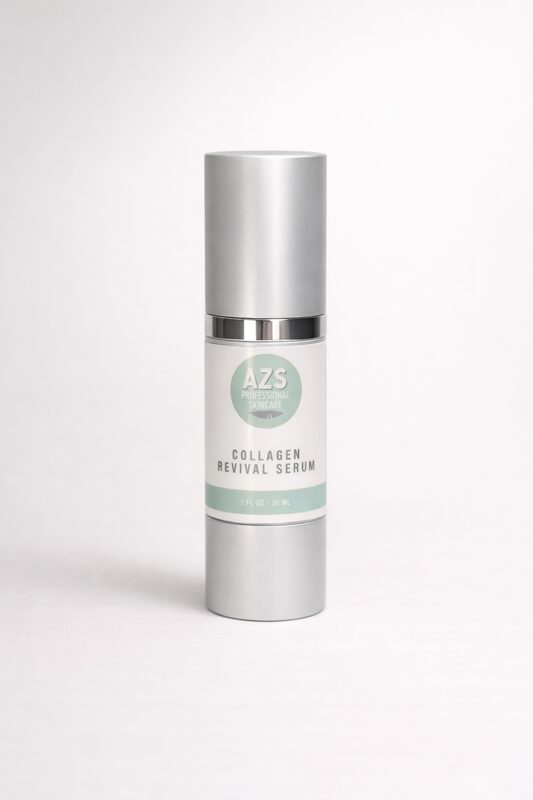
Collagen Revival SERUM Triple Vitamin C · Retinol Gotu Kola · B5 1 oz · AZS

Facial Care · Collagen & Firming Serum

Collagen
Revival
Serum

Triple Vitamin C · Retinyl Palmitate · Gotu Kola · Liposomal Delivery

A serum built on the multi-pathway principle of collagen support. Three distinct forms of Vitamin C — each with a different molecular size, solubility, and mechanism — work alongside Retinyl Palmitate, clinically documented Gotu Kola (Centella Asiatica), dual Vitamin B5, Vitamin E, and a trio of mineral cofactors. The phosphatidylcholine liposomal delivery system carries lipid-soluble actives through the surface layers to where they become bioactive. Not one mechanism — a stacked protocol in a single step. 1oz lasts 2–3 months of daily PM use.

Triple Vitamin C Retinyl Palmitate Gotu Kola Liposomal Delivery Mineral Cofactors Dual Vitamin B5
$48 1 oz · 30 ml · 2–3 months
Qty
1
Used in AZS facial services →
Three Forms of Vitamin C
THD Ascorbate, MAP, Ascorbyl Palmitate — stacked
Liposomal Delivery
Phosphatidylcholine carries actives through the barrier
Gotu Kola Hero Botanical
Clinically documented collagen stimulator
Free Shipping Over $60
Complimentary shipping on qualifying orders
The Triple-C Story

Not one Vitamin C.
Three, by design.

Most serums claim "Vitamin C" as a single ingredient, usually L-Ascorbic Acid at a high percentage. That approach has a well-known problem: L-Ascorbic Acid is unstable, oxidizes rapidly in formula, and is only effective at a narrow pH window that many skin types find irritating. Collagen Revival takes a different path — three stable, bioavailable derivatives of Vitamin C, each targeting a different depth and mechanism.

Tetrahexyldecyl Ascorbate (THD) is oil-soluble and penetrates deepest — research shows it converts into active ascorbate within skin cells at concentrations rivaling L-Ascorbic Acid itself, without the irritation. Magnesium Ascorbyl Phosphate (MAP) is water-soluble, stable at skin-friendly pH, and operates at the surface layer supporting tyrosinase inhibition and brightening. Ascorbyl Palmitate is lipid-compatible and integrates with the skin's barrier lipids, extending antioxidant protection into the barrier itself.

The three forms do not compete — they layer. Different molecular sizes, different routes of absorption, different sites of activity. One cohesive stack, each member doing work the others cannot.

Single-Form Vitamin C
L-Ascorbic at one %
Oxidizes rapidly once opened
Narrow pH window, often irritating
One mechanism, one depth
Short shelf life after first use
Photosensitizing potential
Collagen Revival
Three stable derivatives
THD penetrates lipid-rich deep layers
MAP brightens at surface, pH-friendly
Ascorbyl Palmitate integrates into barrier
Stable for full product life
Non-irritating, PM-compatible with retinol
The Delivery System
Phosphatidylcholine
Phosphatidylcholine (Liposome Phospholipid)
The ingredient that determines whether the actives reach the skin cells where they can do work — or sit on the surface and wash off. Phosphatidylcholine is the primary phospholipid of cell membranes. When formulated into skincare, it spontaneously forms liposomes: microscopic bilayer spheres that mimic the skin's own cell membrane structure. Lipid-soluble actives (THD Ascorbate, Retinyl Palmitate, Vitamin E, Ascorbyl Palmitate, Sunflower Seed Oil-carried botanicals) are encapsulated within these liposomes and carried through the stratum corneum intact, releasing their cargo at the target depth. The result is a serum where the word "penetration" isn't aspirational — it's structural. Without liposomal delivery, half the active ingredients in this formula would underperform; with it, each reaches its site of action.
01
PM use — after cleansing & toning
Apply at night, immediately after cleansing and the Strawberry & Cream Toner's 30-60 second contact window. PM application allows the Retinyl Palmitate and full active stack to work during the skin's natural overnight repair cycle without any UV exposure.
02
3–4 drops, full face
Dispense 3–4 drops into the fingertips. The serum is concentrated — more is not better. Press gently into the skin rather than rubbing. The liposomes do the penetration work; manual pressure isn't what delivers the actives.
03
Wait 60 seconds, then moisturize
Allow the serum a full minute to absorb before following with Berry Barrier Cream or your preferred moisturizer. The wait lets the liposomes complete their penetration rather than being disrupted by the occlusive layer.
04
SPF in the morning — always
The serum is used at night, but its effects are protected in the morning with SPF. Vitamin C and retinoids both increase collagen-supportive activity when photoprotection is consistent. Without daytime SPF, the overnight work is partially undone each day.
The Botanical Cornerstone

Gotu Kola.
Ayurveda's collagen herb,
clinically documented.

Centella Asiatica — known as Gotu Kola — has been used in Ayurvedic and Traditional Chinese Medicine for over two thousand years as a wound-healing and skin-rejuvenating herb. Modern research has done the unusual work of validating that historical use at the molecular level. The active compounds in Centella — asiaticoside, madecassoside, asiatic acid, and madecassic acid — have been documented to stimulate Type I and Type III collagen synthesis, accelerate wound healing, and reduce the visible appearance of scars and photodamage.

In this formula, Gotu Kola is not a trace botanical for a clean label. It is included at meaningful concentration as a functional active, paired with the Vitamin C stack for a compounding effect: Vitamin C is the essential cofactor for collagen synthesis (the enzyme prolyl hydroxylase, which stabilizes the collagen triple helix, literally cannot function without ascorbate), while Centella's triterpenoids upregulate the collagen synthesis pathway itself. One ingredient enables the pathway; the other drives it.

This is what "multi-pathway" means in this serum — not a long ingredient list, but specific biochemical relationships between ingredients that compound each other's activity.

Why the Triterpenoids Matter
Centella's four triterpenoid saponins each operate on a slightly different axis: asiaticoside and madecassoside primarily upregulate collagen synthesis and fibroblast activity; asiatic acid has documented anti-inflammatory activity that reduces the low-grade inflammatory state underlying accelerated aging; madecassic acid supports microcirculation, improving nutrient delivery to the dermal layer. A whole-plant extract captures all four — a single-isolate would not.
Three Forms of Vitamin C

The same vitamin.
Three molecular
pathways.

Each Vitamin C derivative in this formula is characterized by a specific molecular profile: water-soluble or oil-soluble, small or large molecular weight, surface-active or deep-penetrating. Choosing one alone means giving up the work the others would have done. Stacking all three is how you get comprehensive Vitamin C activity in a single application.

Oil-Soluble · Deep
Dermal Penetrator
THD Ascorbate
Tetrahexyldecyl Ascorbate — the most stable and most deeply penetrating Vitamin C derivative in modern cosmetic science. Oil-soluble, which allows it to pass through the lipid-rich stratum corneum intact. Research shows it converts to active ascorbate within skin cells at concentrations comparable to L-Ascorbic Acid, without the pH constraints or irritation. This is the formula's most advanced C ingredient.
Water-Soluble · Surface
Surface Brightener
Magnesium Ascorbyl Phosphate
MAP — a stable, water-soluble Vitamin C derivative that works at the surface and near-surface layers. Documented for tyrosinase inhibition (the enzyme responsible for melanin production), making it effective for reducing hyperpigmentation. Stable at skin-friendly pH of 6–7, unlike L-Ascorbic Acid which requires pH 3.5 to function. Ideal for sensitive skin types that cannot tolerate L-Ascorbic.
Lipid-Compatible · Barrier
Barrier Integrator
Ascorbyl Palmitate
A Vitamin C ester conjugated to palmitic acid. Its lipid compatibility allows it to integrate into the skin's natural barrier lipid matrix and extend antioxidant protection directly into the stratum corneum's defensive layer. Works in tandem with Vitamin E (also in this formula) — the two recycle each other's antioxidant activity, forming a regenerating defense system within the barrier lipids.

The practical result of formulating with three stable C derivatives — rather than one high-percentage L-Ascorbic Acid — is a serum that is effective across all skin types, remains active through its shelf life, and layers safely with Retinyl Palmitate in the same formula. The three forms also compound in their brightening activity: MAP inhibits tyrosinase at the surface while THD works on existing pigmentation in deeper layers, producing a more complete brightening effect than either alone.

Six functional actives.
One compounding protocol.

Beyond the Vitamin C stack and liposomal delivery framework, six additional functional actives address collagen stimulation, cell turnover, antioxidant defense, barrier repair, and mineral cofactor supply. Each was selected for a specific mechanism; none are there for the label.

Antioxidant · Brightening · Collagen
Triple Vitamin C System
THD Ascorbate + MAP + Ascorbyl Palmitate
The three-form Vitamin C architecture of this serum is not a marketing claim — it reflects the biochemistry of ascorbate's role in skin. Vitamin C is the essential cofactor for prolyl and lysyl hydroxylase, the enzymes that stabilize the collagen triple helix during synthesis. Without sufficient ascorbate, newly synthesized collagen is structurally weak and rapidly degraded. Beyond its role in collagen, ascorbate neutralizes free radicals, inhibits tyrosinase (reducing pigmentation), and regenerates oxidized Vitamin E. By providing three stable, bioavailable derivatives at different depths, this formula ensures ascorbate is active where each mechanism needs it — from the lipid-rich deep layers (THD) to the surface epidermis (MAP) to the barrier lipid matrix (Ascorbyl Palmitate).
Cell Turnover · Collagen Stimulation
Retinyl Palmitate (Vitamin A)
Retinyl Palmitate
A gentle, ester form of Vitamin A — the most well-tolerated entry point to the retinoid family. Retinyl Palmitate is converted by skin enzymes, in multiple steps, into retinoic acid, the active form that binds to nuclear retinoid receptors and upregulates cellular processes including keratinocyte turnover, collagen synthesis, and hyaluronic acid production. Because the conversion is gradual, Retinyl Palmitate produces the collagen-stimulating and anti-aging benefits of retinoids with significantly less irritation than prescription tretinoin or higher-strength OTC retinols. This makes it appropriate for first-time retinoid users, for sensitive skin, and for use in combination with Vitamin C — a combination that is often avoided with stronger retinoids due to stability and irritation concerns. Here, the ester stability and the liposomal delivery system make the pairing not only tolerable but synergistic: Vitamin C provides the ascorbate cofactor for the collagen synthesis that the retinoid is upregulating.
Collagen · Healing · Microcirculation
Centella Asiatica (Gotu Kola)
Centella Asiatica (Gotu Kola) Leaf Extract
A whole-plant extract capturing the four primary triterpenoid saponins: asiaticoside, madecassoside, asiatic acid, and madecassic acid. Modern research has validated Gotu Kola's traditional use as a skin-rejuvenating herb — the triterpenoids are documented to stimulate Type I and Type III collagen synthesis, accelerate fibroblast proliferation, improve microcirculation at the dermal capillary level, and reduce the appearance of scars and photoaging. Paired with the Vitamin C stack, the effect is compounding: Vitamin C is required as a cofactor for collagen synthesis; Gotu Kola upregulates the pathway that synthesizes collagen. One ingredient enables the pathway; the other drives it. Centella also has significant anti-inflammatory activity through its triterpenoids, which reduces the chronic low-grade inflammation associated with accelerated skin aging.
Barrier · Repair · Hydration
Dual Vitamin B5 System
Panthenol + Calcium Pantothenate
Vitamin B5 is represented here in two distinct forms: Panthenol, the alcohol form that converts to pantothenic acid on skin, and Calcium Pantothenate, the mineral salt that provides a direct source of the active vitamin. The dual-form approach mirrors the Vitamin C strategy: different absorption profiles, different depths of action. Pantothenic acid is a precursor to Coenzyme A, which is central to every cellular repair and synthesis process — including the fatty acid synthesis that produces barrier ceramides. Panthenol alone has documented barrier-repair, anti-inflammatory, and deep humectant activity; adding Calcium Pantothenate supplements the pool of available B5 during the overnight repair cycle when cellular activity is at its peak. A deeply repairing combination that softens the skin's response to active ingredients like retinoids and Vitamin C.
Antioxidant · Barrier Lipid
Vitamin E (Tocopherol Acetate)
Tocopherol Acetate
The stable ester form of Vitamin E — one of the most established antioxidants in cosmetic chemistry, and specifically chosen in this formula for its synergy with the Vitamin C system. Vitamins C and E recycle each other: when Vitamin E neutralizes a free radical, it becomes oxidized and inactive until Vitamin C regenerates it back to active form. This cycle extends the antioxidant activity of both vitamins far beyond what either would provide alone. Vitamin E also integrates directly into the skin's barrier lipid matrix, defending the stratum corneum's lipid components from peroxidation — the oxidative damage that breaks down barrier lipids and causes water loss. In a formula with this many active ingredients, Vitamin E's protective function against oxidation also extends to the other actives themselves, stabilizing the formula.
Cofactor · Healing · Mineral
Zinc + Magnesium Cofactors
Zinc Gluconate + Magnesium Gluconate
The overlooked mechanism of skin health: trace minerals as enzymatic cofactors. Zinc is required for over 300 enzymes, including the matrix metalloproteinases involved in collagen remodeling, and is foundational for wound-healing and epithelial repair. Topical zinc also has documented sebum-regulating and anti-inflammatory activity, useful for skin types prone to reactive flares when introducing new actives. Magnesium is a cofactor for DNA repair enzymes and the ATP synthesis that powers every other cellular process, including the overnight repair cycle this serum is designed to support. Both are provided in gluconate form — the gluconic acid conjugate — for better skin compatibility and absorption than sulfate or oxide forms. They don't drive a single visible result, but every active above them works better because these are present.

Twenty-four ingredients.
Every one named.

No percentages — formulation ratios are proprietary — but every ingredient by name, phase, and function. No synthetic fragrance, no undisclosed actives. What you apply to your skin is exactly what is listed here.

Phase A · Water Base
Deionized Water (Aqua)
Purified water — the aqueous solvent for the water-soluble actives (MAP, sodium hyaluronate, panthenol, calcium pantothenate, mineral gluconates). Deionized to remove trace metal ions that would destabilize the ascorbate derivatives.
Phase A · Humectant
Glycerin
The foundational humectant of serum formulation. Draws and holds moisture at the skin surface, contributes to the serum's silky skin-feel, and stabilizes the aqueous actives in solution. Plant-derived, non-comedogenic, compatible with every other ingredient in the formula.
Phase A · Humectant
Propanediol
1,3-Propanediol from corn fermentation — lighter and faster-absorbing than glycerin. Contributes humectancy and functions as a penetration-enhancer for the water-soluble actives. Pairs with glycerin to provide both surface moisture and rapid uptake.
Phase B · Emulsifier
Olivem 1000
Cetearyl Olivate + Sorbitan Olivate
The olive-derived liquid-crystal emulsifier. Structures the serum's oil and water phases into a bio-mimetic emulsion that resembles the skin's own lamellar lipid matrix. Non-irritating, non-comedogenic, enhances barrier repair rather than disrupting it. The same emulsifier system used in Berry Barrier Cream.
Phase C · Vitamin C Stack
Oil-Soluble · Deep
Tetrahexyldecyl Ascorbate
THD Ascorbate — the most stable and deeply penetrating Vitamin C derivative available. Oil-soluble, passes through lipid-rich stratum corneum intact, converts to active ascorbate within skin cells. Research documents effectiveness comparable to L-Ascorbic Acid without pH constraints or irritation.
Phase C · Vitamin C Stack
Water-Soluble · Surface
Magnesium Ascorbyl Phosphate
MAP — stable water-soluble Vitamin C derivative. Tyrosinase-inhibiting and brightening at the epidermal surface. Effective at skin-friendly pH 6–7, unlike L-Ascorbic Acid's required pH 3.5. Non-irritating, suitable for sensitive skin.
Phase C · Vitamin C Stack
Lipid-Compatible · Barrier
Ascorbyl Palmitate
Vitamin C ester conjugated to palmitic acid. Integrates directly into the skin's barrier lipid matrix, extending antioxidant protection into the barrier layer. Recycles Vitamin E — together they form a self-regenerating antioxidant system within the barrier.
Phase C · Vitamin A
Retinyl Palmitate
Ester form of Vitamin A — the gentlest entry point to the retinoid family. Converts in multiple enzymatic steps to retinoic acid, which upregulates cell turnover, collagen synthesis, and hyaluronic acid production. Significantly less irritating than tretinoin or high-strength retinol, suitable for daily use and pairing with Vitamin C.
Phase C · Vitamin B5
Panthenol (Provitamin B5)
Converts to pantothenic acid on skin. Supports epithelial cell proliferation, barrier repair, and intracellular water binding. Anti-inflammatory. Softens the skin's response to retinoids and Vitamin C while contributing its own repair activity.
Phase C · Vitamin B5
Calcium Pantothenate
The mineral salt of pantothenic acid — direct source of active Vitamin B5. Pairs with Panthenol to provide sustained B5 availability for the overnight repair cycle. Precursor to Coenzyme A, central to fatty acid synthesis and barrier ceramide production.
Phase C · Vitamin E
Tocopherol Acetate (Vitamin E)
Stable ester form of Vitamin E. Primary barrier-lipid antioxidant. Recycles the oxidized Vitamin C back to active form and is in turn recycled by ascorbate — a self-regenerating antioxidant pair. Also stabilizes the other actives in the formula against oxidation.
Phase C · Hydration
Sodium Hyaluronate
The sodium salt form of hyaluronic acid — holds up to 1,000× its weight in water. Delivered in the serum's liposome-enriched base for deeper penetration than conventional HA serums. Plumps the skin visibly within minutes of application and supports the collagen-stimulating actives with improved cellular hydration.
Phase C · Mineral Cofactor
Zinc Gluconate
Topical zinc in the gluconate form — cofactor for 300+ enzymes including matrix metalloproteinases involved in collagen remodeling. Sebum-regulating and anti-inflammatory. Foundational for wound-healing and epithelial repair. The gluconate conjugate provides better skin compatibility than sulfate or oxide forms.
Phase C · Mineral Cofactor
Magnesium Gluconate
Magnesium cofactor for DNA repair enzymes and ATP synthesis — the cellular energy system that powers every repair and synthesis pathway. Delivered alongside zinc to support the full cellular repair cascade active during overnight use of this serum.
Phase C · Delivery System
Liposomal Encapsulator
Phosphatidylcholine
The primary phospholipid of cell membranes. In formula, spontaneously forms liposomes — bilayer spheres that encapsulate lipid-soluble actives (THD, Retinyl Palmitate, Vitamin E, Ascorbyl Palmitate) and carry them through the stratum corneum intact. The ingredient that determines whether the active stack penetrates or sits on the surface.
Phase C · Carrier Oil
Sunflower Seed Oil
High-oleic sunflower oil — the lipid carrier for the oil-soluble actives (THD Ascorbate, Retinyl Palmitate, Ascorbyl Palmitate, Vitamin E). Also contributes its own barrier-supporting linoleic acid content and naturally occurring tocopherols. Non-comedogenic, compatible with all skin types.
Phase D · Botanical Actives
Hero Botanical
Centella Asiatica (Gotu Kola)
Whole-plant extract capturing asiaticoside, madecassoside, asiatic acid, and madecassic acid. Documented in modern research to stimulate Type I and III collagen synthesis, accelerate fibroblast activity, and improve microcirculation. Paired with the Vitamin C stack for compounding collagen support.
Phase D · Botanical Antioxidants
Green Tea Leaf Extract
EGCG-rich Camellia sinensis extract providing potent antioxidant protection and anti-inflammatory activity. Layers with the Vitamin C and Vitamin E antioxidant system for multi-source defense — polyphenols from plants, ascorbate and tocopherol from the vitamin stack.
Phase D · Botanical Antioxidants
Rosemary Leaf Extract
Rich in carnosic acid and rosmarinic acid — two of the most potent antioxidants in the culinary-herb family. Protects the formula's lipid-soluble actives from oxidation and contributes its own anti-inflammatory and circulation-supporting activity to the skin.
Phase D · Botanical Soothing
Aloe Vera Leaf Extract
Acemannan polysaccharide content contributes anti-inflammatory and wound-healing activity. Softens the skin's response to the retinoid and Vitamin C actives. Contributes additional humectancy to the water phase and a cooling, calming sensory quality on application.
Phase E · Texture
Xanthan Gum
Plant-derived polysaccharide — the natural texture stabilizer. Provides the serum's light-gel body that allows it to spread evenly without running, while keeping the active stack in suspension. Absorbs completely without residue.
Phase F · Preservation
Ethylhexylglycerin
Glyceryl ether — natural-derived preservation booster and skin-conditioning agent. Works alongside Potassium Sorbate to provide broad-spectrum preservation without parabens, formaldehyde-releasers, or phenoxyethanol. Also contributes to the serum's smooth application feel.
Phase F · Preservation
Potassium Sorbate
Natural-derived preservative effective against yeast, mold, and fungi. Paired with Ethylhexylglycerin for broad-spectrum coverage. Well-tolerated, non-irritating, food-grade safe. Keeps the formula stable through its shelf life.
On transparency: Every ingredient named and explained. No percentages — our formulation ratios are proprietary. No "fragrance," no "parfum," no undisclosed actives. The formula's natural aromatic character comes entirely from the botanical extracts — rosemary, green tea, gotu kola, aloe — listed here by name and function.

Collagen support is
never one mechanism.

Multi-Pathway Collagen Support
Vitamin C provides the cofactor that collagen synthesis enzymes cannot function without. Retinyl Palmitate upregulates the collagen synthesis pathway itself. Gotu Kola's triterpenoids activate fibroblasts to synthesize Type I and Type III collagen. Zinc is the cofactor for collagen remodeling. Four distinct mechanisms in the same serum, each compounding the work of the others.
Progressive Brightening
Three Vitamin C derivatives addressing pigmentation from different angles: MAP inhibits tyrosinase at the surface, THD reaches deeper pigmentation in the dermis, and Retinyl Palmitate accelerates the turnover of pigmented surface cells. Combined with Gotu Kola's ability to reduce the appearance of scars and photodamage, the brightening effect compounds over six to twelve weeks of consistent PM use.
Layered Antioxidant Defense
A self-regenerating antioxidant cycle: Vitamin E protects barrier lipids, Vitamin C regenerates oxidized Vitamin E, and Ascorbyl Palmitate extends this cycle into the barrier lipid matrix itself. Layered over this are the plant polyphenols — rosemary's rosmarinic acid, green tea's EGCG, Gotu Kola's triterpenoids — providing a multi-source defense against UV and pollution damage.
Liposomal Penetration
Phosphatidylcholine forms liposomes that carry the lipid-soluble actives through the stratum corneum intact, delivering them to the depth where they become bioactive rather than sitting on the surface. This is the mechanical difference between a serum that feels active and a serum that measurably works — penetration is not aspirational here, it is structural.
Gentle Enough for Daily Use
The Vitamin C derivatives avoid the pH constraints and irritation of L-Ascorbic Acid. Retinyl Palmitate is the mildest retinoid ester. Panthenol, Calcium Pantothenate, aloe, and gotu kola provide anti-inflammatory and soothing activity that buffers the introduction of retinoids and actives. Appropriate for sensitive skin types typically unable to tolerate standard Vitamin C and retinol regimens.
Visible Firmness Over Time
The collagen-stimulating actives produce effects that compound across weeks, not days. Expect visible improvements in firmness, elasticity, and fine-line softening over four to twelve weeks of consistent PM use. Early results — improved surface texture and brightness — appear within two to four weeks. Long-term results — structural firmness — require continued use past the three-month mark.
Collagen Revival Serum 1 oz · AZS

PM application.
The overnight protocol.

A collagen-supportive serum is doing its most important work during the skin's natural overnight repair cycle. The retinoid in this formula also makes PM-only use the correct choice — daytime application would partially undo the work through photodegradation. A morning routine with SPF preserves what happened overnight.

Apply PM only — after cleansing and toning
Use at night, immediately after cleansing and the Strawberry & Cream Toner's 30–60 second contact window. The actives — particularly Retinyl Palmitate and the Vitamin C stack — work during the skin's natural overnight repair cycle without daytime UV exposure that would partially degrade them.
3–4 drops into fingertips
Dispense 3–4 drops into the fingertips of both hands. This is a concentrated formula — more is not better, and using more can reduce absorption as the serum pools on the surface instead of penetrating. The 1oz bottle is sized for this concentration.
Press — don't rub — into skin
Press the serum gently into the skin with flat fingertips, moving from the center of the face outward. Don't rub or drag. The liposomes do the penetration work at the molecular level — manual pressure is not what delivers the actives, and vigorous rubbing can disrupt the liposome structure before it has done its job.
Wait 60 seconds before moisturizer
Give the serum a full minute to absorb before applying Berry Barrier Cream or your nighttime moisturizer. The wait allows the liposomes time to complete their penetration rather than being disrupted by the occlusive moisturizer layer going on too quickly.
Consistent PM use — introduce gradually
For first-time retinoid users, start with 2–3 nights per week for the first two weeks, then increase to every other night, then nightly as tolerated. Visible firmness and brightening compound across 4–12 weeks of consistent use. Morning SPF is essential — without it, the overnight work is partially undone each day.
A note on usage
A 1oz bottle with 3–4 drops per application provides approximately 90–120 uses — two to three months of nightly use, or closer to four months at three times per week. The per-use cost reflects the density of actives: three Vitamin C derivatives, a retinoid, a liposomal delivery system, a whole-plant Gotu Kola extract, and dual Vitamin B5 in one formulation. Pregnant or nursing: consult your physician before use due to the Vitamin A content.

You May Also Like

Berry Barrier
Berry Barrier Cream Moisturizer
The moisturizer that seals the serum's active work. Apply Berry Barrier Cream immediately after the serum's 60-second absorption window. The Olivem 1000 emulsion locks in the liposome-delivered actives and the strawberry hydrosol base contributes its own antioxidant layer — the two products share the same emulsifier system and layer cleanly.
Strawberry & Cream Toner
The preparation step before the serum. The toner's niacinamide and HA prime the skin with hydration before the collagen-stimulating actives are applied, and the 30–60 second toner contact window gives the skin time to absorb moisture before the serum's absorption begins. The full AZS PM routine: cleanse, tone, serum, moisturize.
Grapefruit Grove Botanical Wash
The cleanser that begins the PM routine. Grapefruit Grove removes the day's SPF, sebum, and environmental residue without stripping the barrier lipids — critical before applying a serum with this many actives. The Saccharide Isomerate, Beta-Glucan, and Panthenol in the wash leave the skin prepared to receive the toner and serum layers that follow.