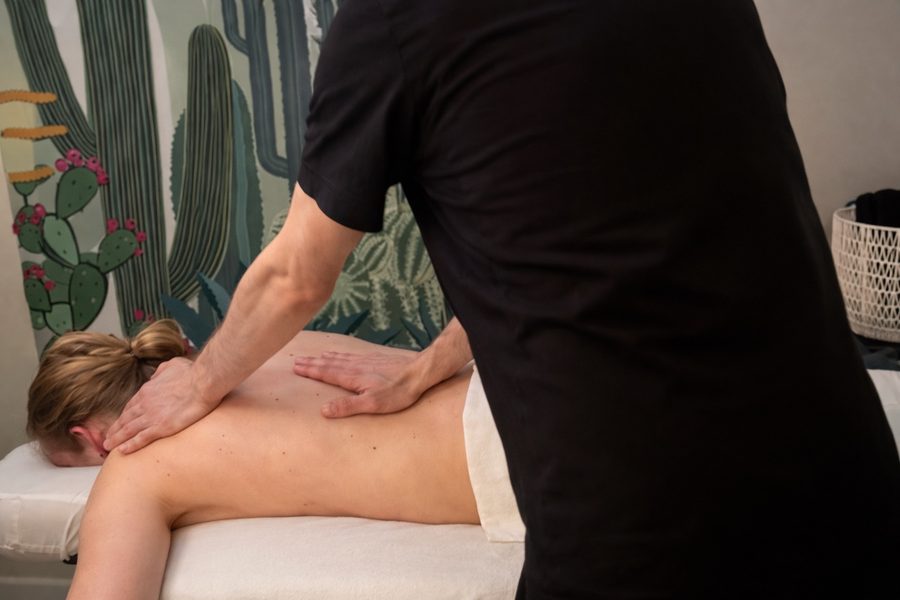
There’s a phrase massage therapists hear constantly: “I just want Swedish.” The word “just” is doing a lot of work there. It implies that Swedish massage is the lesser option — the starter option, something you choose when you don’t really need anything. The therapeutic equivalent of decaf.
This perception is wrong, and it costs people. Because Swedish massage, when it’s performed with real skill and genuine presence, is one of the most effective interventions available for a nervous system under siege. And most nervous systems, most of the time, are under siege.
What Swedish actually does
The five classical Swedish techniques — effleurage, petrissage, friction, tapotement, vibration — are not arbitrary. Each works with tissue and the nervous system in a specific way. Together, they create a sustained invitation for the parasympathetic nervous system to take over from the sympathetic. That shift — from fight-or-flight to rest-and-digest — is measurable. It shows up in cortisol levels, heart rate variability, and muscle tension. It’s not relaxation in the loose sense of the word. It’s physiological regulation.
For people living in chronic stress — which is most people — that regulation is not a luxury. It’s medicine. The body needs windows of genuine recovery to repair, consolidate, and reset. A skilled Swedish session is one of the most direct routes to that window.
It isn’t the warm-up option. For a nervous system that hasn’t been allowed to stop, it may be the most targeted thing you can receive.
What gets missed when you always go deep
There’s something else worth saying: Swedish massage reaches tissue that deep tissue work can’t. The superficial structures — the skin, the fascia just beneath it, the lymphatic network — respond specifically to lighter, longer strokes. These structures matter. Lymphatic circulation, skin health, surface tissue hydration — all of these are served by the kind of contact that isn’t trying to get past them.
People who always default to the deepest possible work miss out on the benefits that surface-layer contact provides. Not everything that matters in the body is buried. And sometimes the most therapeutic thing is not to go deeper, but to stay present with what’s actually on the surface and meet it there.
The skill it actually requires
A massage therapist who can work at every layer with equal skill is offering something more complete than one who only knows how to go hard. Swedish is not the absence of skill. In many ways, it requires more — because nothing is hidden in heavy pressure.
The work asks you to stay present with what’s subtle. To feel the nervous system shifting under your hands. To know when a long effleurage stroke is doing more work than a thumb technique ever could. To trust that slowness is not weakness, that gentleness is not passivity, that meeting the body where it is — rather than where you think it should be — is sometimes the most sophisticated clinical decision you can make.
Most people are surprised by how much they’re holding in their bodies until they’re invited to stop. A skilled Swedish session creates those conditions. The word “just” has no place in that.