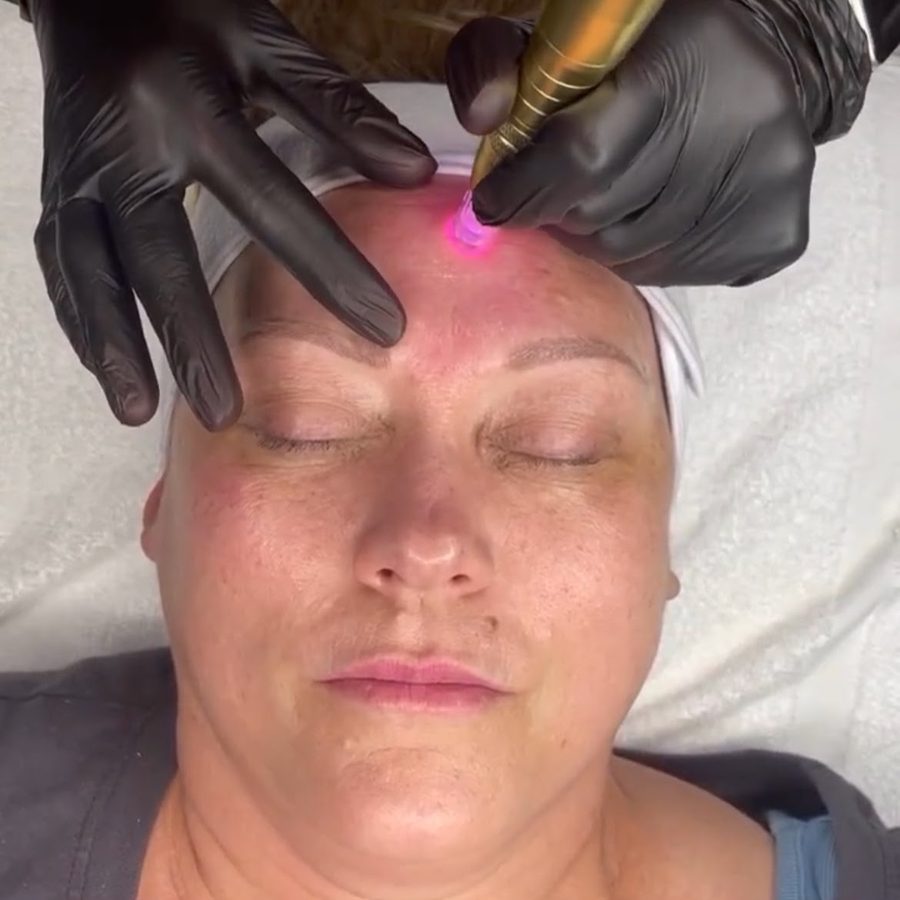
The principle behind microneedling is, on its surface, counterintuitive. You want better skin. To get it, a device creates thousands of tiny injuries in the surface of your skin. Your skin responds to those injuries. And in responding, it produces something better than what was there before.
This sounds like it shouldn’t work. But it does — consistently, measurably, and for a wider range of concerns than most treatments can claim.
The mechanism is the wound-healing cascade. When the skin perceives injury (even micro-injury), it initiates a repair response: fibroblasts are activated, growth factors flood the area, collagen and elastin production accelerates, and the tissue remodels. The needles are creating a signal. The skin responds to that signal. The practitioner is, in a real sense, putting the skin’s own intelligence to work.
What this means practically
Collagen induction therapy — the clinical name for what microneedling does — is backed by a substantial body of evidence. The research is clearest for acne scarring, fine lines, textural irregularity, and enlarged pores. But the effects extend to hyperpigmentation, sun damage, dullness, and early laxity. Almost any concern where the underlying structure of the skin is part of the problem responds to structural intervention.
This is different from treatments that work at the surface. A serum can hydrate and support. An exfoliant can resurface. But neither one stimulates the dermis to produce new collagen. Microneedling does. And the serum applied during treatment benefits from this too: the micro-channels the needles create allow active ingredients to penetrate the dermis far more deeply than topical application alone can achieve.
The skin’s healing response is not a side effect — it is the treatment. The needles are a signal. The skin provides the repair.
What the recovery actually looks like
Microneedling is not a walk-out-and-go treatment. There’s real recovery involved — a day of redness and warmth, a few days of tightness and possible flaking, then a return to normal appearance around day four to seven. The collagen remodeling continues for weeks after that. Results from a single session are often visible four to six weeks post-treatment.
That timeline surprises some people. They expect to see the improvement right away, the way they might after dermaplaning or a chemical peel. Microneedling is working deeper, on a slower schedule, changing something more fundamental. The patience required is proportional to the kind of change on offer.
Why a series changes everything
For concerns like acne scarring or significant textural irregularity, a single session is a beginning, not a conclusion. The most meaningful results come from a series — typically three to six sessions spaced four weeks apart — where each treatment builds on the collagen response of the last. The skin that shows up for session three is already different from the skin that came in for session one.
Many clients who complete a series notice something they find hard to describe at first: the skin doesn’t just look different, it behaves differently. Products absorb better. Breakouts heal faster. The texture that felt entrenched for years begins to soften. That’s structural change — and it’s not something you can achieve from the surface.
Microneedling works because it doesn’t try to fix the skin. It asks the skin to fix itself. And given the right signal, the right conditions, and enough time — it usually does.