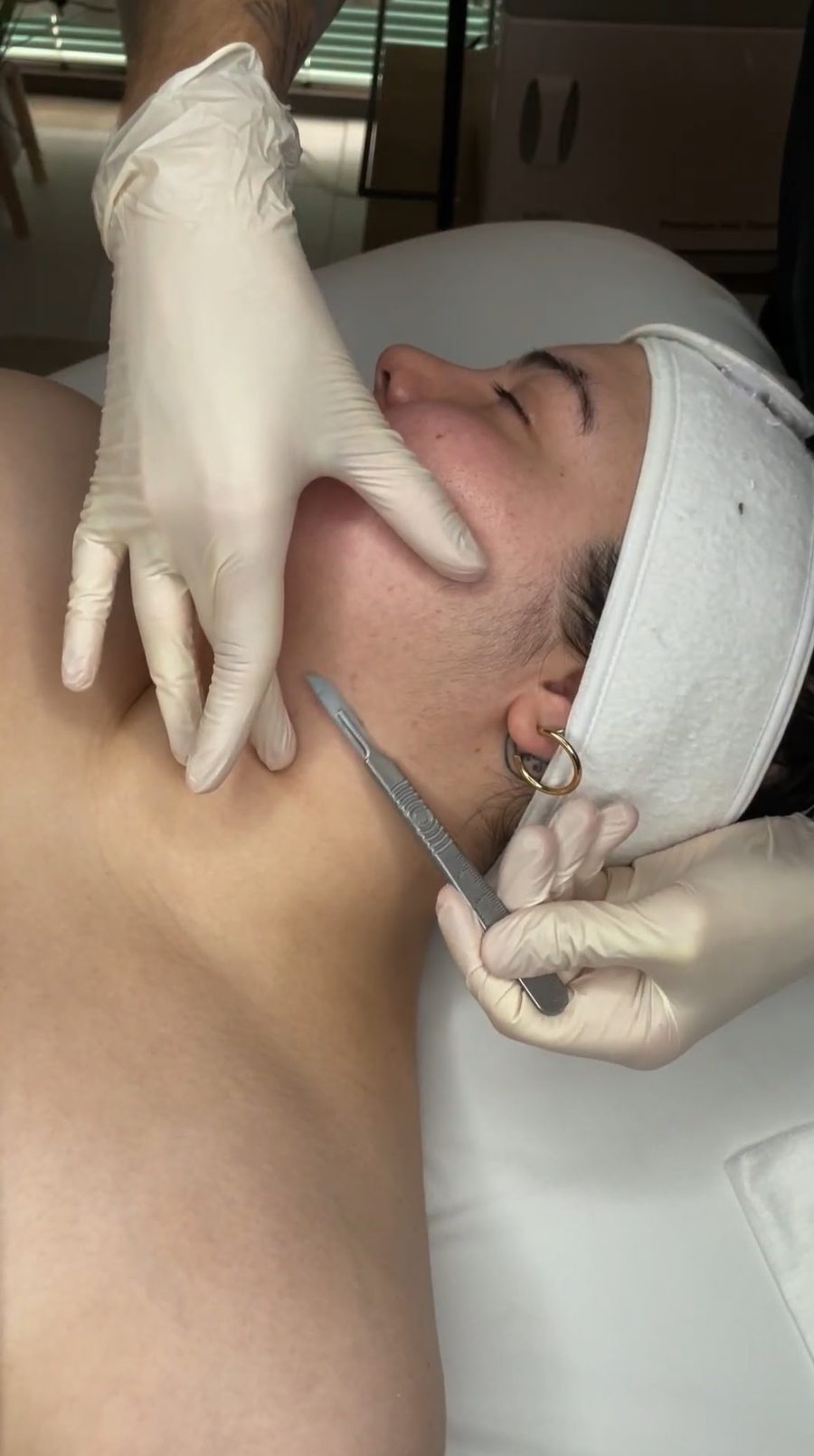
The word “scalpel” stops people. You hear “surgical-grade blade” and something in you wants to politely decline and leave. That’s a reasonable first reaction. Knives near the face are generally a thing to be cautious about.
But dermaplaning is one of the most satisfying facial treatments available — and the hesitation almost always dissolves in the first thirty seconds. Because the sensation is nothing like what people imagine. It’s not sharp. It’s not scary. It feels, genuinely, like a credit card being swept gently across your skin. Light. Consistent. Strangely meditative.
What the blade is doing is methodical and controlled: removing the outermost layer of dead skin cells and the fine vellus hair (peach fuzz) that covers the face. The esthetician holds it at a precise 45-degree angle and works in small, deliberate strokes with the grain of the hair. It requires training and steady hands, and in the right hands, it’s one of the more low-risk ways to achieve deep exfoliation — without chemicals, without downtime, without anything that asks your skin to recover.
The myth that won’t die
There are a few things people get wrong about dermaplaning, but one keeps coming back: the belief that vellus hair will grow back thicker and darker after it’s been removed.
This is not true. It has been studied and confirmed repeatedly, and it’s worth being direct about it: vellus hair (peach fuzz) is structurally different from terminal hair (the kind that grows on your head or chin). Cutting it at the surface does not change its color, texture, or growth rate. What grows back is the same fine, light hair that was there before. The perception of darkness comes from the blunt cut end, which can look different in light immediately after treatment — but the hair itself is unchanged.
This myth has kept a lot of people from a treatment they’d otherwise love. It doesn’t deserve that power.
The hesitation almost always dissolves in the first thirty seconds. What people imagine and what they experience are rarely the same thing.
What you’ll notice immediately
Results from dermaplaning are immediate. Not “you’ll see improvement over the next few weeks” immediate — actually immediate. You can feel the difference before you’ve left the treatment room.
The skin is luminously smooth. Products absorb differently — faster, more evenly. Foundation sits on the skin instead of sitting on texture and hair. If you wear makeup, you’ll likely notice this the first time you apply it post-treatment: it glides in a way that feels new.
Zero downtime. No redness for most clients. You can return to your day immediately — which, in the landscape of skin treatments, is genuinely unusual. Most clients who do it once are on a monthly schedule by their second appointment. Not because they were sold on it, but because they experienced it and made the calculation themselves.
Who it’s actually for
Dermaplaning tends to work especially well for people with dull or dry skin looking for immediate radiance, those bothered by visible facial peach fuzz, and anyone who’s sensitive to chemical exfoliants and hasn’t found a physical option that feels safe. It’s also an excellent starting point if you’ve been curious about professional skin care but aren’t sure where to begin — the results are immediate and there’s nothing to wait for.
What dermaplaning is not good for: active acne in the treatment area. Spreading bacteria across broken skin is exactly what we’re trying to avoid. If you’re dealing with hormonal acne along the jaw, a conversation with your esthetician before booking can help determine whether dermaplaning is appropriate for your specific pattern, or whether another approach makes more sense.
For everyone else: the scalpel is far less dramatic than it sounds. Most clients leave wondering why they hesitated.