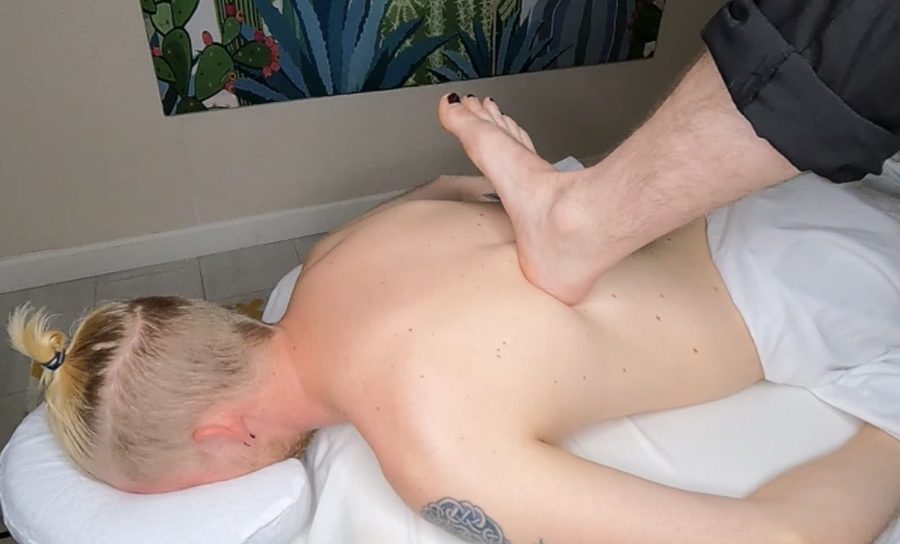
There’s a specific frustration that brings people to ashiatsu. It usually sounds something like: “I’ve tried deep tissue everywhere and it never really gets there.” Or: “The pressure always feels like too much in the moment, but afterward I didn’t feel like anything really changed.”
These are real experiences, and they make sense. The human hand, for all its precision, has limitations. The thumb can go deep, the elbow can go very deep — but both deliver concentrated pressure through a small contact point. At a certain depth, that concentration starts to feel sharp, even intrusive. The nervous system braces. The release you’re trying to access closes off.
The foot is different.
Broad surface, deep pressure
Ashiatsu delivers pressure through the arch, heel, and toe — a contact area dramatically larger than any hand technique. That broad surface distributes the weight across a wider zone, which means the sensation at any single point is less concentrated. The result: the nervous system doesn’t brace in the same way. The tissue stays receptive. The work can go genuinely, profoundly deep — often deeper than anything the hands could achieve — without the sharp, intrusive quality that causes guarding.
The therapist works from overhead bars, using them to control exactly how much of their body weight is applied at any moment. The pressure is precisely modulated. You are never receiving someone’s full weight. What you’re receiving is a carefully calibrated expression of it.
This is not walking on someone’s back. It’s a refined, credentialed technique with specific protocols for safety and effectiveness. The bars are not a novelty — they are the mechanism that makes control possible.
The foot distributes rather than concentrates. That’s what lets it go deep without going past you.
What people are usually surprised by
The thing most first-time ashiatsu clients don’t expect is how peaceful it feels. The broad contact, the slower strokes, the gravity-assisted quality of the work — all of it combines into something that reads as powerful but not aggressive. Many people describe it as the most effective massage they’ve ever experienced. Some describe it as the first time they’ve genuinely felt like the work reached where they needed it to go.
Afterward, there’s often a quality of release in the paraspinals and major muscle groups that’s hard to describe. Length, ease, a feeling of structural spaciousness. Some clients notice that their back feels longer. That’s not imaginary — the gliding strokes along the paraspinals can create traction that decompresses the spaces between vertebrae in a way that’s nearly impossible with hand techniques.
For people who’ve been looking
Ashiatsu is ideal for larger-bodied or heavily muscled clients where hand pressure simply reaches its limit, for athletes with dense tissue that doesn’t respond to conventional work, and for anyone who has walked out of session after session wondering if anything actually changed.
It’s also appropriate for a wider range of bodies than people assume. Depth is always a conversation, always calibrated to the person on the table. What ashiatsu offers is not “more pressure, no matter what” — it offers access. A way to reach tissue that would otherwise stay protected. For people who’ve been looking for that: this tends to be it.